Customer Experience (CX): Definition, Importance, and Strategies for Success
Tue, 25 February 2025

Severity: Warning
Message: file_get_contents(http://www.geoplugin.net/json.gp?ip=216.73.216.239): Failed to open stream: HTTP request failed! HTTP/1.1 403 Forbidden
Filename: helpers/location_helper.php
Line Number: 77
Backtrace:
File: /home/sprintzeal.org/public_html/application/helpers/location_helper.php
Line: 77
Function: file_get_contents
File: /home/sprintzeal.org/public_html/application/controllers/Blog.php
Line: 109
Function: location_details
File: /home/sprintzeal.org/public_html/index.php
Line: 289
Function: require_once
Follow the stories of academics and their research expeditions

Cognitive AI refers to cognitive artificial intelligence systems that mimic human-like thinking and decision-making processes. It combines machine learning, natural language processing, computer vision,and other technologies to analyze data, understand context, and learn from inter actions, just like the human brain.
Essentially, it's AI that can learn, adapt, and reason, rather than just following pre-programmed instructions.
In 2026, Cognitive AI ibm research and other industry leaders show that cognitive AI is not a fixed system but a dynamic technology that learns from its environment, adapts in real time, and produces context-aware insights.
It processes unstructured data such as text, voice, and images, applying advanced reasoning and natural human-like interactions to enhance decision-making, boost operational efficiency, and deliver personalized experiences across industries.
Beyond traditional AI, Cognitiveclass AI and related platforms teach how cognitive AI fuses machine learning, deep learning, and cognitive computing principles to mimic human thought, learning continuously from behavior, emotions, and interactions.
Powered by hybrid edge-cloud architectures, it supports real-time intelligence in sectors like healthcare, finance, manufacturing, and supply chains—enabling seamless human-machine collaboration that evolves with changing needs.
To dive deeper, you can explore a full cognitiveclass ibm guide to Cognitive AI in later sections of this article.
Cognitive Computing and AI (2026)
In 2026, cognitive computing works hand-in-hand with cognitive artificial intelligence (AI) to think and learn more like humans. These systems are built to understand emotions, behavior, and logic, helping people make better and faster decisions.
Unlike traditional AI, cognitive computing focuses on understanding context and human intent. It can process huge amounts of information from different sources, analyze patterns, and respond in a way that feels natural and human-like.
This is made possible by advanced tools like natural language processing (NLP), real-time pattern detection, and multi-modal AI that can work with text, speech, images, and sensor data at the same time.
Today, cognitive ai ibm is used in healthcare to improve diagnosis, in finance to predict market changes, in customer service to give personalized responses, and in research to solve complex problems. Its main strength is the ability to keep learning from new data, adapt to changing situations, and offer solutions quickly and accurately.
What’s even fascinating about the future of AI with cognitive computing is that, rather than being a specific system, it is designed to learn from the environment to engage and conclude results.
Cognitive AI brings resilient performance management by learning the unstructured data, extracting, reasoning with results, and interacting with humans as programmed in a natural manner like humans.
The revolutionary technological changes have created a greater need for applying AI for Natural Language Processing (NLP), speech or voice recognition, contract or image processing, unstructured data, and chatbots.
The machine system learns, extracts, iterates, and results from the interaction of emotion, impulse, and cognition of situated agents with human beings and their behaviour, experience, or environment.
Cognitive computing extends over or past with Artificial Intelligence and includes a similar tech approach to boost cognitive utilization.
To draw more about the guide to cognitive AI, we have provided a brief guide to cognitive AI in this article.
Cognitive AI works by learning from large amounts of data—whether it is text, speech, images, or interactions—and using advanced techniques like natural language processing (NLP), machine learning, and deep reasoning to make sense of it.
It continuously adapts by detecting complex patterns and connections in the data, which helps it provide meaningful insights and support better decision-making for humans. This ability to learn and evolve from new information, without interruption, sets Cognitive artificial intelligence apart from traditional systems.
These systems mimic human thinking by interpreting information, reasoning through problems, and interacting naturally with users through chatbots or other interfaces.
For example, Cognitive ai ibm models can analyze a job seeker's skills and preferences to suggest suitable career paths or salary ranges, making it easier for people to find relevant opportunities.
In the best sense, cognitive computing with AI technologies relies on driven solutions to resolve issues. These can be through the help of data extraction, data mining, facial recognition, speech recognition, NLP, and others.
The system is made to learn, iterate, reason, state, and interact like humans. Such systems and chatbots work with concepts and symbols as well.
For instance; AI approaches to direct the system to assess the skills of a user trying to find a job, while cognitive computing suggests career paths or salaries, or job vacancies. T works hand-in-hand to make decisions-based easier for humans.
Also, cover related blogs: 7 Amazing Facts About Artificial Intelligence
Below are the main characteristics of Cognitive AI:
Learns, adapts, and reasons in real time by mimicking human cognitive processes. It evolves continuously through interactions with users, experiences, and changing environments.
Seamlessly connects and communicates with devices, cloud services, applications, and users to enable smooth and natural interactions.
Remembers past interactions and activities to refine analysis, solve unresolved issues, and improve over time through continuous learning.
Understands the meaning and relevance of data by analyzing factors like user behavior, language patterns, demographics, time, and situation, delivering tailored insights from both structured and unstructured data.
Draws logical conclusions from complex data, continuously improving its knowledge through experience to support better decision-making.
Uses natural language processing to interpret and generate human-like responses, enhancing communication and making interactions intuitive.
The best applications of Cognitive AI involve;
Detects and predicts cyber threats, vulnerabilities, and software bugs using advanced analytics.
Uses encryption, situational awareness, and automated self-patching to secure communication and data systems.
Assists doctors by collecting, analyzing, and interpreting medical data for diagnosis and treatment planning.
Supports life sciences research and personalized healthcare solutions through cognitiveclass ai trained professionals
Understands human language in context to automate analysis, reasoning, and decision-making.
Reduces manual effort and streamlines business processes and management tasks.
Creates high-quality content faster than manual processes.
Continuously improves through learning, reasoning, and mimicking human creativity and psychology.
Connects and optimizes devices for data exchange and automation.
Delivers personalized experiences, e.g., tailoring social media feeds or smart home interactions.
Goal: Mimics human thought processes to support decision-making rather than replace it.
Focus: Uses computer science + cognitive science to solve complex, context-heavy problems.
Capabilities: Emotion analysis, facial recognition, fraud detection, and understanding unstructured data.
Role: Extracts and presents information so humans can make informed decisions.
Applications: Customer service, healthcare diagnostics, industrial problem-solving, and advisory systems.
Goal: Broader in scope—automates tasks, solves problems, and makes decisions independently.
Focus: Delivers optimal solutions by detecting patterns, predicting outcomes, and adapting through learning.
Capabilities: Uses deep learning, machine learning, and large-scale data analysis to operate like (or beyond) humans.
Role: Enhances or replaces human effort to improve speed, accuracy, and scalability.
Applications: Finance, manufacturing, security, healthcare, retail, logistics, and more.
Cognitive AI is transforming decision-making by making machines smarter and easier for humans to work with. Its applications span many fields—from automating grading in education to enabling advanced features in autonomous vehicles and predicting trends in the travel industry.
From education for automating grading systems to autonomous vehicles for advanced features or travel industries for predicting pricing patterns, the applications of cognitive AI will grow even more in demand. Having an Artificial Intelligence Career Guide from experts is the best option. Considering how Artificial Intelligence Has Made Understanding Consumer Buying Behavior Easy In 2026, there are higher benefits of taking cognitive AI into action.
If you are looking forward to pursuing a career in cognitive artificial Intelligence, choosing from a globally recognized ATO (An accredited training organization) from Sprintzeal accelerates your career of interest. The Artificial Intelligence training – online, live, and classroom is specifically designed for professionals with a keen interest in cognitive ai ibm skills, AI, and Machine learning.
To learn about career-oriented all courses, you can take up the training offered by Sprintzeal and earn a certification to level up your career. For details about certification programs or queries in your field, Click Here or chat with our experts, and our course experts will get to you. Subscribe to our newsletters for recent trends and informative details.
Cognitive AI refers to cognitive artificial intelligence systems that mimic human-like thinking and decision-making processes. It combines machine learning, natural language processing, computer vision,and other technologies to analyze data, understand context, and learn from inter actions, just like the human brain.
Essentially, it's AI that can learn, adapt, and reason, rather than just following pre-programmed instructions.
In 2026, Cognitive AI ibm research and other industry leaders show that cognitive AI is not a fixed system but a dynamic technology that learns from its environment, adapts in real time, and produces context-aware insights.
It processes unstructured data such as text, voice, and images, applying advanced reasoning and natural human-like interactions to enhance decision-making, boost operational efficiency, and deliver personalized experiences across industries.
Beyond traditional AI, Cognitiveclass AI and related platforms teach how cognitive AI fuses machine learning, deep learning, and cognitive computing principles to mimic human thought, learning continuously from behavior, emotions, and interactions.
Powered by hybrid edge-cloud architectures, it supports real-time intelligence in sectors like healthcare, finance, manufacturing, and supply chains—enabling seamless human-machine collaboration that evolves with changing needs.
To dive deeper, you can explore a full cognitiveclass ibm guide to Cognitive AI in later sections of this article.
Cognitive Computing and AI (2026)
In 2026, cognitive computing works hand-in-hand with cognitive artificial intelligence (AI) to think and learn more like humans. These systems are built to understand emotions, behavior, and logic, helping people make better and faster decisions.
Unlike traditional AI, cognitive computing focuses on understanding context and human intent. It can process huge amounts of information from different sources, analyze patterns, and respond in a way that feels natural and human-like.
This is made possible by advanced tools like natural language processing (NLP), real-time pattern detection, and multi-modal AI that can work with text, speech, images, and sensor data at the same time.
Today, cognitive ai ibm is used in healthcare to improve diagnosis, in finance to predict market changes, in customer service to give personalized responses, and in research to solve complex problems. Its main strength is the ability to keep learning from new data, adapt to changing situations, and offer solutions quickly and accurately.
What’s even fascinating about the future of AI with cognitive computing is that, rather than being a specific system, it is designed to learn from the environment to engage and conclude results.
Cognitive AI brings resilient performance management by learning the unstructured data, extracting, reasoning with results, and interacting with humans as programmed in a natural manner like humans.
The revolutionary technological changes have created a greater need for applying AI for Natural Language Processing (NLP), speech or voice recognition, contract or image processing, unstructured data, and chatbots.
The machine system learns, extracts, iterates, and results from the interaction of emotion, impulse, and cognition of situated agents with human beings and their behaviour, experience, or environment.
Cognitive computing extends over or past with Artificial Intelligence and includes a similar tech approach to boost cognitive utilization.
To draw more about the guide to cognitive AI, we have provided a brief guide to cognitive AI in this article.
Cognitive AI works by learning from large amounts of data—whether it is text, speech, images, or interactions—and using advanced techniques like natural language processing (NLP), machine learning, and deep reasoning to make sense of it.
It continuously adapts by detecting complex patterns and connections in the data, which helps it provide meaningful insights and support better decision-making for humans. This ability to learn and evolve from new information, without interruption, sets Cognitive artificial intelligence apart from traditional systems.
These systems mimic human thinking by interpreting information, reasoning through problems, and interacting naturally with users through chatbots or other interfaces.
For example, Cognitive ai ibm models can analyze a job seeker's skills and preferences to suggest suitable career paths or salary ranges, making it easier for people to find relevant opportunities.
In the best sense, cognitive computing with AI technologies relies on driven solutions to resolve issues. These can be through the help of data extraction, data mining, facial recognition, speech recognition, NLP, and others.

The system is made to learn, iterate, reason, state, and interact like humans. Such systems and chatbots work with concepts and symbols as well.
For instance; AI approaches to direct the system to assess the skills of a user trying to find a job, while cognitive computing suggests career paths or salaries, or job vacancies. T works hand-in-hand to make decisions-based easier for humans.
Also, cover related blogs: 7 Amazing Facts About Artificial Intelligence
Below are the main characteristics of Cognitive AI:
Learns, adapts, and reasons in real time by mimicking human cognitive processes. It evolves continuously through interactions with users, experiences, and changing environments.
Seamlessly connects and communicates with devices, cloud services, applications, and users to enable smooth and natural interactions.
Remembers past interactions and activities to refine analysis, solve unresolved issues, and improve over time through continuous learning.
Understands the meaning and relevance of data by analyzing factors like user behavior, language patterns, demographics, time, and situation, delivering tailored insights from both structured and unstructured data.
Draws logical conclusions from complex data, continuously improving its knowledge through experience to support better decision-making.
Uses natural language processing to interpret and generate human-like responses, enhancing communication and making interactions intuitive.
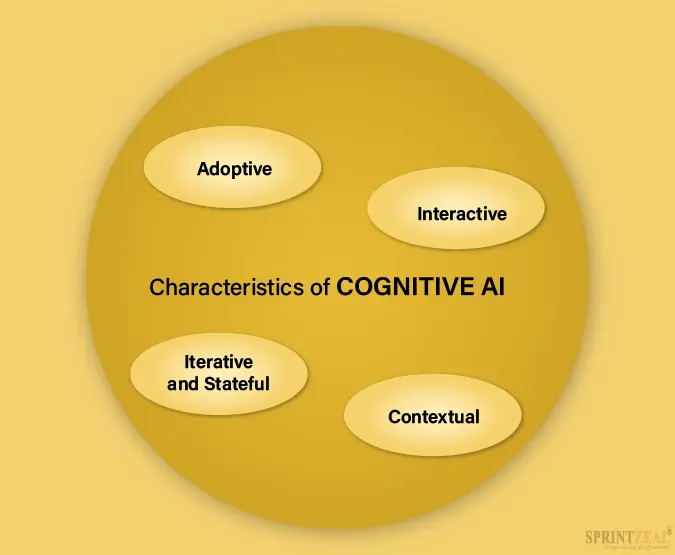
The best applications of Cognitive AI involve;
Detects and predicts cyber threats, vulnerabilities, and software bugs using advanced analytics.
Uses encryption, situational awareness, and automated self-patching to secure communication and data systems.
Assists doctors by collecting, analyzing, and interpreting medical data for diagnosis and treatment planning.
Supports life sciences research and personalized healthcare solutions through cognitiveclass ai trained professionals
Understands human language in context to automate analysis, reasoning, and decision-making.
Reduces manual effort and streamlines business processes and management tasks.
Creates high-quality content faster than manual processes.
Continuously improves through learning, reasoning, and mimicking human creativity and psychology.
Connects and optimizes devices for data exchange and automation.
Delivers personalized experiences, e.g., tailoring social media feeds or smart home interactions.
Goal: Mimics human thought processes to support decision-making rather than replace it.
Focus: Uses computer science + cognitive science to solve complex, context-heavy problems.
Capabilities: Emotion analysis, facial recognition, fraud detection, and understanding unstructured data.
Role: Extracts and presents information so humans can make informed decisions.
Applications: Customer service, healthcare diagnostics, industrial problem-solving, and advisory systems.
Goal: Broader in scope—automates tasks, solves problems, and makes decisions independently.
Focus: Delivers optimal solutions by detecting patterns, predicting outcomes, and adapting through learning.
Capabilities: Uses deep learning, machine learning, and large-scale data analysis to operate like (or beyond) humans.
Role: Enhances or replaces human effort to improve speed, accuracy, and scalability.
Applications: Finance, manufacturing, security, healthcare, retail, logistics, and more.

Cognitive AI is transforming decision-making by making machines smarter and easier for humans to work with. Its applications span many fields—from automating grading in education to enabling advanced features in autonomous vehicles and predicting trends in the travel industry.
From education for automating grading systems to autonomous vehicles for advanced features or travel industries for predicting pricing patterns, the applications of cognitive AI will grow even more in demand. Having an Artificial Intelligence Career Guide from experts is the best option. Considering how Artificial Intelligence Has Made Understanding Consumer Buying Behavior Easy In 2026, there are higher benefits of taking cognitive AI into action.
If you are looking forward to pursuing a career in cognitive artificial Intelligence, choosing from a globally recognized ATO (An accredited training organization) from Sprintzeal accelerates your career of interest. The Artificial Intelligence training – online, live, and classroom is specifically designed for professionals with a keen interest in cognitive ai ibm skills, AI, and Machine learning.
To learn about career-oriented all courses, you can take up the training offered by Sprintzeal and earn a certification to level up your career. For details about certification programs or queries in your field, Click Here or chat with our experts, and our course experts will get to you. Subscribe to our newsletters for recent trends and informative details.

Nchumbeni Yanthan
Nchumbeni, a content specialist, creates easy-to-understand educational content, helping diverse clients and millions of learners achieve career goals with clarity and impact.
Tue, 25 February 2025
Mon, 31 March 2025

Tue, 25 February 2025


© 2024 Sprintzeal Americas Inc. - All Rights Reserved.

 USA : +1315-322-7821
 UK : +44 7700 174870
 IND : +919008230179
 AUS : +61 480 005 455
Leave a comment