Customer Experience (CX): Definition, Importance, and Strategies for Success
Tue, 25 February 2025

Follow the stories of academics and their research expeditions

Welcome to the digital age, where protecting personal data privacy of personal data is crucial. Strong information assurance practices must be implemented by organisations due to the increase in cyber threats.
Discover about the information assurance model and how it contributes to the protection of our digital assets in this article. Investigating its importance in the realm of cybersecurity and how it forms the basis for protecting sensitive data would be beneficial.
So grab a cup of coffee and learn the secrets of information assurance model and its importance in today's linked world.
Information assurance encompasses the policies, processes, and technologies employed to protect and manage information assets. The Information Assurance Model provides a structured approach to achieving this goal.
It consists of four key components:

Confidentiality
Safeguarding data from unauthorized access ensures that only authorized individuals can access and view sensitive information. Encryption, access controls, and secure communication protocols play a pivotal role in maintaining confidentiality.
Example: An organization implements strong encryption protocols to protect customer data during transmission. To keep your data locked away from prying eyes, organizations employ advanced encryption algorithms like AES (Advanced Encryption Standard) or RSA (Rivest-Shamir-Adleman).
These algorithms act like digital bodyguards, ensuring that even if someone manages to intercept your data, it's like reading a jumble of secret code.
Integrity
Maintaining data integrity ensures that information remains accurate, complete, and unaltered throughout its lifecycle. Techniques such as data validation, checksums, and digital signatures are employed to detect and prevent unauthorized modifications.
Example: A financial institution employs data validation techniques in its banking systems.
When you make a transaction, the system is there to safeguard your data's integrity. It carefully checks if everything matches the rules and criteria in place.
If anything seems off, like an incorrect account number or an unusually large transaction amount, the system steps in as a protector and blocks the transaction. This ensures that your data remains accurate and shielded, preserving the trustworthiness of your information.
Availability
To ensure information availability, resilient systems and processes are crucial. This information assurance model component checks on backup and disaster recovery strategies, redundancy measures, and proactive monitoring.
Example: an e-commerce website ensures uninterrupted service by employing multiple synchronized servers and a load balancer. This smart setup evenly distributes incoming requests, preventing disruptions caused by server failures or sudden traffic surges.
As a result, customers can seamlessly browse, shop, and complete transactions, even during peak times or when a server encounters issues.
Non-Repudiation
Non-repudiation ensures that the origin and integrity of data cannot be denied by the sender. Digital signatures, audit trails, and timestamping mechanisms are utilized to provide evidence of the authenticity and integrity of digital transactions.
Example: An organization implements a digital signature mechanism in its document management system. A distinct cryptographic signature is generated and added to the document when it is digitally signed by an authorised user. This signature prevents the signer from later disputing their involvement in the document by providing proof of the document's integrity, legitimacy, and identity.
To comprehend the urgency and relevance of information assurance, let's consider some eye-opening statistics:
-According to a report by Risk Based Security, in 2021 alone, there were over 5,258 reported data breaches, exposing more than 1 billion records.
-The Ponemon Institute's Cost of Cyber Crime report revealed that the average cost of a data breach in 2021 was a staggering $4.24 million.
-A study by Verizon showed that 85% of successful data breaches involved some form of human interaction, such as social engineering or phishing attacks.
These statistics underscore the pressing need for organizations to implement robust information assurance measures to mitigate the risk of cyber threats.
Let's dive into some real-world examples and best practices that showcase how organizations implement the Information Assurance Model:
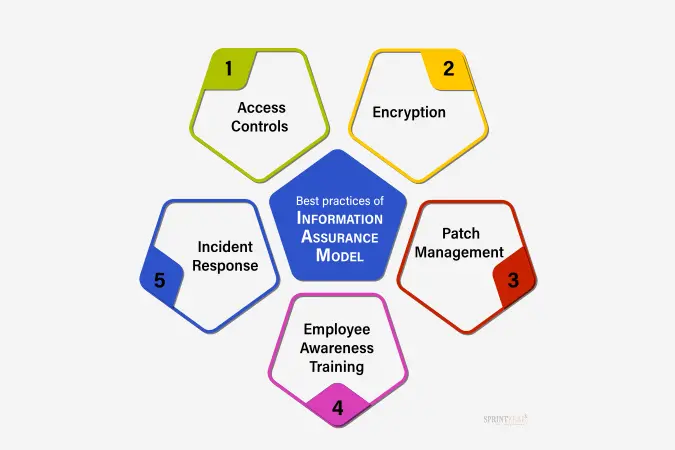
Access Controls
Organizations put measures in place to control who can access sensitive data. It involves the use of secure passwords, two-factor authentication (such as inputting a number delivered to your phone), and role-based access control (which grants access depending on employment duties).
By doing this, they offer an additional degree of protection by making sure that only authorised individuals may access the data.
Encryption
Encryption transforms sensitive information into a secret code, ensuring its protection. To prevent unauthorized access and secure communication, techniques like Transport Layer Security (TLS) are employed. Even if someone intercepts the data, they cannot decipher its meaning without the decryption key.
Patch Management
Keeping software up to date is crucial for cybersecurity. Regularly applying security patches and updates to operating systems, applications, and network devices helps address known vulnerabilities. By doing this, organizations minimize the risk of exploitation by hackers who might try to exploit those vulnerabilities.
Employee Awareness Training
Organizations invest in training their employees to be cybersecurity savvy. This includes teaching them how to identify phishing attempts (fake emails that try to trick you into sharing sensitive information), practicing good password hygiene (like using strong passwords and not sharing them), and reporting any suspicious activities they come across.
By making employees aware of these best practices of information assurance model, organizations strengthen their defense against cyber-attacks.
Incident Response
During a security breach, an effective incident response plan is vital. It minimizes damage, investigates the breach, and restores normal operations swiftly. This plan ensures prompt action and prevents further harm.
By implementing the Information Assurance Model, organizations protect their data and systems. These examples and best practices of information assurance model establish a strong security framework, defending against cyber threats and keeping sensitive information safe.

Strengthen your existing cybersecurity expertise, by pursuing certification courses related to the Information Assurance Model can open doors to exciting opportunities.
Certified Information Systems Security Professional (CISSP)
A highly recognized certification offered by (ISC)², focusing on various domains of information security, including governance, risk management, cryptography, and security operations.
Certified Information Security Manager (CISM)
This certification is designed for professionals responsible for managing an enterprise's information security program. It covers topics such as information security governance, risk management, incident management, and program development.
Certified Information Systems Auditor (CISA)
CISA is ideal for professionals involved in auditing, control, and security of information systems. It emphasizes topics such as information system governance, risk management, and acquisition, development, and implementation of information systems.
CompTIA Security+
It is a foundational certification that imparts a thorough knowledge of cybersecurity ideas and best practises. It includes subjects including incident response, risk management, and network security.
GIAC Security Essentials (GSEC)
This certification validates an individual's understanding of information security concepts and technologies. It covers areas such as access controls, network security, and cryptography.
Certified Information Privacy Professional (CIPP)
This certification focuses on privacy regulations and best practices. It equips professionals with knowledge about privacy laws, data protection strategies, and privacy program management.
EC-Council Certified Ethical Hacker (CEH)
This certification trains professionals to think like hackers and identify vulnerabilities in systems. It covers topics such as network scanning, system hacking, and ethical hacking methodologies.
ISACA Certified in the Governance of Enterprise IT (CGEIT)
CGEIT is designed for professionals responsible for governance and strategic management of IT resources. It emphasizes areas like IT governance frameworks, strategic alignment, and risk management.
Offensive Security Certified Professional (OSCP)
This certification focuses on practical skills in penetration testing and ethical hacking. It requires hands-on experience and assesses the ability to identify and exploit vulnerabilities in systems.
ISACA Certified Information Systems Auditor (CISA)
CISA focuses on auditing, control, and security of information systems. These certification courses delve into essential topics like information system governance, risk management, and information systems development. They equip professionals with the necessary expertise to thrive in the ever-changing realm of information assurance.
By earning these certifications, individuals showcase their proficiency in safeguarding information assets, managing risks, and implementing robust cybersecurity measures.
Are you looking to upskill your cybersecurity career? Look no further than Sprintzeal's comprehensive cybersecurity courses. These courses are the ideal method to keep ahead in this quickly expanding industry because they are made to provide professionals with the most recent knowledge and abilities.
You can select the course that best suits your professional objectives from options like Certified Information Systems Security Professional (CISSP), Certified Information Security Manager (CISM), and CCSP Certification Training Course (CCSP). Whether you're interested in information security governance, risk management, or ethical hacking, Sprintzeal has got you covered.
Don't miss out on the opportunity to boost your professional credentials and stand out in the competitive cybersecurity landscape.
In today's digital landscape, information assurance is crucial for ensuring the security and accessibility of sensitive data. By embracing the Information Assurance Model, organizations can proactively protect themselves against emerging cyber threats.
It's essential for stakeholders to understand the importance of information assurance and allocate resources to strengthen their cybersecurity defenses. This builds trust among customers, partners, and stakeholders while mitigating the devastating consequences of data breaches.
Are you ready to level up your skills? Explore Sprintzeal's cybersecurity courses and unlock your potential today! Contact us now to embark on your journey to success.
Welcome to the digital age, where protecting personal data privacy of personal data is crucial. Strong information assurance practices must be implemented by organisations due to the increase in cyber threats.
Discover about the information assurance model and how it contributes to the protection of our digital assets in this article. Investigating its importance in the realm of cybersecurity and how it forms the basis for protecting sensitive data would be beneficial.
So grab a cup of coffee and learn the secrets of information assurance model and its importance in today's linked world.
Information assurance encompasses the policies, processes, and technologies employed to protect and manage information assets. The Information Assurance Model provides a structured approach to achieving this goal.
It consists of four key components:
Confidentiality
Safeguarding data from unauthorized access ensures that only authorized individuals can access and view sensitive information. Encryption, access controls, and secure communication protocols play a pivotal role in maintaining confidentiality.
Example: An organization implements strong encryption protocols to protect customer data during transmission. To keep your data locked away from prying eyes, organizations employ advanced encryption algorithms like AES (Advanced Encryption Standard) or RSA (Rivest-Shamir-Adleman).
These algorithms act like digital bodyguards, ensuring that even if someone manages to intercept your data, it's like reading a jumble of secret code.
Integrity
Maintaining data integrity ensures that information remains accurate, complete, and unaltered throughout its lifecycle. Techniques such as data validation, checksums, and digital signatures are employed to detect and prevent unauthorized modifications.
Example: A financial institution employs data validation techniques in its banking systems.
When you make a transaction, the system is there to safeguard your data's integrity. It carefully checks if everything matches the rules and criteria in place.
If anything seems off, like an incorrect account number or an unusually large transaction amount, the system steps in as a protector and blocks the transaction. This ensures that your data remains accurate and shielded, preserving the trustworthiness of your information.
Availability
To ensure information availability, resilient systems and processes are crucial. This information assurance model component checks on backup and disaster recovery strategies, redundancy measures, and proactive monitoring.
Example: an e-commerce website ensures uninterrupted service by employing multiple synchronized servers and a load balancer. This smart setup evenly distributes incoming requests, preventing disruptions caused by server failures or sudden traffic surges.
As a result, customers can seamlessly browse, shop, and complete transactions, even during peak times or when a server encounters issues.
Non-Repudiation
Non-repudiation ensures that the origin and integrity of data cannot be denied by the sender. Digital signatures, audit trails, and timestamping mechanisms are utilized to provide evidence of the authenticity and integrity of digital transactions.
Example: An organization implements a digital signature mechanism in its document management system. A distinct cryptographic signature is generated and added to the document when it is digitally signed by an authorised user. This signature prevents the signer from later disputing their involvement in the document by providing proof of the document's integrity, legitimacy, and identity.
To comprehend the urgency and relevance of information assurance, let's consider some eye-opening statistics:
-According to a report by Risk Based Security, in 2021 alone, there were over 5,258 reported data breaches, exposing more than 1 billion records.
-The Ponemon Institute's Cost of Cyber Crime report revealed that the average cost of a data breach in 2021 was a staggering $4.24 million.
-A study by Verizon showed that 85% of successful data breaches involved some form of human interaction, such as social engineering or phishing attacks.
These statistics underscore the pressing need for organizations to implement robust information assurance measures to mitigate the risk of cyber threats.
Let's dive into some real-world examples and best practices that showcase how organizations implement the Information Assurance Model:
Access Controls
Organizations put measures in place to control who can access sensitive data. It involves the use of secure passwords, two-factor authentication (such as inputting a number delivered to your phone), and role-based access control (which grants access depending on employment duties).
By doing this, they offer an additional degree of protection by making sure that only authorised individuals may access the data.
Encryption
Encryption transforms sensitive information into a secret code, ensuring its protection. To prevent unauthorized access and secure communication, techniques like Transport Layer Security (TLS) are employed. Even if someone intercepts the data, they cannot decipher its meaning without the decryption key.
Patch Management
Keeping software up to date is crucial for cybersecurity. Regularly applying security patches and updates to operating systems, applications, and network devices helps address known vulnerabilities. By doing this, organizations minimize the risk of exploitation by hackers who might try to exploit those vulnerabilities.
Employee Awareness Training
Organizations invest in training their employees to be cybersecurity savvy. This includes teaching them how to identify phishing attempts (fake emails that try to trick you into sharing sensitive information), practicing good password hygiene (like using strong passwords and not sharing them), and reporting any suspicious activities they come across.
By making employees aware of these best practices of information assurance model, organizations strengthen their defense against cyber-attacks.
Incident Response
During a security breach, an effective incident response plan is vital. It minimizes damage, investigates the breach, and restores normal operations swiftly. This plan ensures prompt action and prevents further harm.
By implementing the Information Assurance Model, organizations protect their data and systems. These examples and best practices of information assurance model establish a strong security framework, defending against cyber threats and keeping sensitive information safe.
Strengthen your existing cybersecurity expertise, by pursuing certification courses related to the Information Assurance Model can open doors to exciting opportunities.
Certified Information Systems Security Professional (CISSP)
A highly recognized certification offered by (ISC)⊃2;, focusing on various domains of information security, including governance, risk management, cryptography, and security operations.
Certified Information Security Manager (CISM)
This certification is designed for professionals responsible for managing an enterprise's information security program. It covers topics such as information security governance, risk management, incident management, and program development.
Certified Information Systems Auditor (CISA)
CISA is ideal for professionals involved in auditing, control, and security of information systems. It emphasizes topics such as information system governance, risk management, and acquisition, development, and implementation of information systems.
CompTIA Security+
It is a foundational certification that imparts a thorough knowledge of cybersecurity ideas and best practises. It includes subjects including incident response, risk management, and network security.
GIAC Security Essentials (GSEC)
This certification validates an individual's understanding of information security concepts and technologies. It covers areas such as access controls, network security, and cryptography.
Certified Information Privacy Professional (CIPP)
This certification focuses on privacy regulations and best practices. It equips professionals with knowledge about privacy laws, data protection strategies, and privacy program management.
EC-Council Certified Ethical Hacker (CEH)
This certification trains professionals to think like hackers and identify vulnerabilities in systems. It covers topics such as network scanning, system hacking, and ethical hacking methodologies.
ISACA Certified in the Governance of Enterprise IT (CGEIT)
CGEIT is designed for professionals responsible for governance and strategic management of IT resources. It emphasizes areas like IT governance frameworks, strategic alignment, and risk management.
Offensive Security Certified Professional (OSCP)
This certification focuses on practical skills in penetration testing and ethical hacking. It requires hands-on experience and assesses the ability to identify and exploit vulnerabilities in systems.
ISACA Certified Information Systems Auditor (CISA)
CISA focuses on auditing, control, and security of information systems. These certification courses delve into essential topics like information system governance, risk management, and information systems development. They equip professionals with the necessary expertise to thrive in the ever-changing realm of information assurance.
By earning these certifications, individuals showcase their proficiency in safeguarding information assets, managing risks, and implementing robust cybersecurity measures.
Are you looking to upskill your cybersecurity career? Look no further than Sprintzeal's comprehensive cybersecurity courses. These courses are the ideal method to keep ahead in this quickly expanding industry because they are made to provide professionals with the most recent knowledge and abilities.
You can select the course that best suits your professional objectives from options like Certified Information Systems Security Professional (CISSP), Certified Information Security Manager (CISM), and CCSP Certification Training Course (CCSP). Whether you're interested in information security governance, risk management, or ethical hacking, Sprintzeal has got you covered.
Don't miss out on the opportunity to boost your professional credentials and stand out in the competitive cybersecurity landscape.
In today's digital landscape, information assurance is crucial for ensuring the security and accessibility of sensitive data. By embracing the Information Assurance Model, organizations can proactively protect themselves against emerging cyber threats.
It's essential for stakeholders to understand the importance of information assurance and allocate resources to strengthen their cybersecurity defenses. This builds trust among customers, partners, and stakeholders while mitigating the devastating consequences of data breaches.
Are you ready to level up your skills? Explore Sprintzeal's cybersecurity courses and unlock your potential today! Contact us now to embark on your journey to success.

Niharika Chaurasia
Niharika is a technical content writer in the education niche with vast experience in creating content for certifications and training programs. She creates engaging, easy-to-understand, and valuable content for both beginners and professionals aspiring to enhance their careers.
Tue, 25 February 2025
Mon, 31 March 2025

Tue, 25 February 2025


© 2024 Sprintzeal Americas Inc. - All Rights Reserved.

 USA : +1315-322-7821
 UK : +44 7700 174870
 IND : +919008230179
 AUS : +61 480 005 455
Leave a comment