Machine Learning Interview Questions and Answers 2026
Mon, 09 December 2024

Follow the stories of academics and their research expeditions
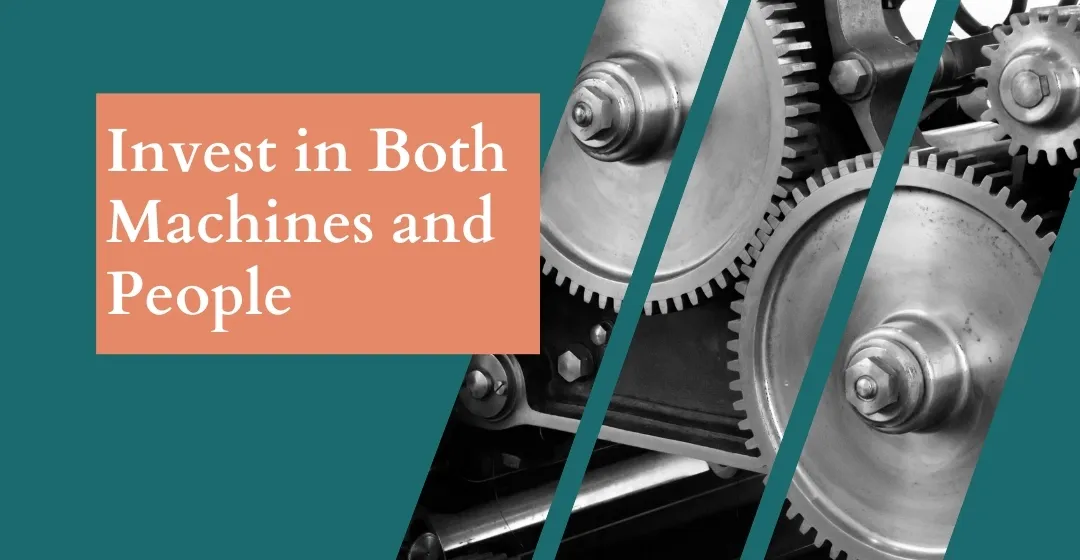
Visit any busy factory floor and two things immediately stand out. First, the working of machines — cutting, welding, and assembling with breathtaking speed and precision. Second, the watchful eyes of skilled operators who guide the process, step in when problems arise, and fine-tune operations to keep things moving.
Modern manufacturing depends on this exact balance. Machines bring speed, accuracy, and consistency. People bring adaptability, problem-solving, and judgment. Lean too far into one, and you lose the value of the other.
A cutting-edge machine can double output — but without the right people, it won’t reach its potential. Likewise, a talented team can’t perform at its best when held back by outdated tools. The smartest manufacturers know this. They’re not just upgrading their tech — they’re also creating environments where people can thrive alongside it.
So what does a well-balanced investment strategy really look like? And how do forward-thinking businesses manage to grow both capacity and talent without tipping the scales? In this article, you’ll discover why prioritizing both machines and people isn’t just smart — it’s essential for the future of manufacturing.
Machines are searching for means of saving time. What would previously take workers a whole day to accomplish is now possible within hours. The increase in efficiency is a blessing to businesses, especially when customers' needs are expanding. Shortening production cycles enables businesses to do more without loss of quality. Workers also stand to gain much from this revolution. Instead of repeating the same thing over and over, they can apply their energy to jobs that require analysis or creativity.
Many manufacturers accelerate turnaround times by integrating advanced processes such as CNC machining, which allows for automated, high-precision production with minimal material waste. By leveraging programmable cutting and shaping capabilities, businesses can maintain consistent output while freeing skilled workers to focus on oversight and optimization rather than repetitive manual tasks.
Accuracy is the norm in most industries today. Errors are expensive and will destroy the image of a company. Precision machines make accuracy the norm. Many manufacturers enhance results further by using precision CNC machining services for consistent and high-quality production.
For instance, a CNC plasma table can cut metals with amazing accuracy, minimizing waste and delivering better results. The best part is that they are attached to the table, a pair of rails that contribute to the X-axis. In addition, you can also improve the working with accessories, such as drills and oxyfuel. All of this pleases both employees and clients, who eventually come back for additional orders.
The upfront cost of state-of-the-art machinery appears expensive, but manufacturers consider the larger picture. Equipment saves waste by not wasting materials. It reduces the cost per unit by producing more in less time. Much modern equipment is designed with energy conservation in mind and thus conserves costs too. In a matter of years, such savings will generally outlast the initial investment. Practically, this translates into the ability of businesses to sustain decent margins and invest in development initiatives.
Manufacturing is no longer regional competition. A firm in one part of the country is routinely competing head-to-head with firms half a globe away. It is important to ensure the quality and speed to survive. Machines make such a scale of competition possible. Automation keeps lines running, guarantees repeatable outcomes, and enables companies to ship foreign orders on time. Firms embracing new technology can become dependable world suppliers, while laggards are vulnerable to being left behind.
Another sense in which machines are beneficial is that they can be applied to risky or back-straining tasks. Jobs like heavy lifting, welding in the heat, or cutting hard materials are easier to do with machines. The workplace is not only less likely to be accident-swept, but morale is also greater overall. Workers can stay healthier while machines physically perform the most stressful work.
When businesses expand, manual processes alone often cannot keep up. Machines make scaling operations realistic. Whether demand doubles or triples, equipment can be adjusted to meet new targets without requiring an equal rise in workforce size. This scalability helps companies respond quickly to opportunities and secure contracts they might otherwise miss.
Machines are great at taking orders, but not everything can be anticipated. Production lines experience issues from material defects to unexpected technical breakdowns. When this occurs, individuals intervene. Trained personnel diagnose the issue, make choices, and fine-tune procedures in a manner to maintain operations. Without humans, even minor problems might balloon into humongous backlogs. Flexibility and decision-making are something machines can't match.
It requires human ingenuity behind every new product or process innovation. Employees who spend most of their days near machines will seek to cut costs or streamline operations. They leverage common sense and hands-on experience. Involving employees' participation in idea-sharing generates continuous improvements. Some will save minutes per process, but others can save thousands of dollars in production costs. Either way, innovation comes to life when people care about the process.
There is no machine that is not subject to wear and tear. Routine maintenance guarantees long-term stability, and it is performed by skilled professionals. Employees are aware when a system must be repaired, so minor problems do not become major breakdowns. Safety is also an important consideration. Although machines are powerful, they can become dangerous if not properly supervised. Seasoned employees safeguard themselves, others nearby, and the equipment by ensuring standards of safety are always maintained.
Industries evolve, and technology is changing day by day. The latest technology of tomorrow becomes old technology yesterday. Companies realize the importance of a flexible workforce. Training programs are run to make employees capable of working with new tools and machines. A trained workforce allows companies to adapt to technological changes with minimal disruption. Investing in people allows companies to create a future for equipment and personnel to grow together and become resistant to capricious markets.
Equipment can make products, but not build culture. It is people who build teamwork, leadership, and communication—the secret to any business's success. Healthy working relationships build trust and cooperation, which result in easier-to-manage businesses. A content team operates not just harder but also looks out for each other, lowering turnover and providing greater stability.
Markets shift quickly, either by way of economic trends, consumer tastes, or supply disruptions. Humans can shift gears and adapt processes in ways machinery can't. Human laborers provide vision and flexibility, characteristics that enable companies to keep their heads above water in turbulent times. Such flexibility keeps manufacturers up to date even when industries suddenly turn in new directions.
The case must never be machines versus people, or people versus machines. It's a question of understanding how the one enhances the other. Machines bring efficiency, reliability, and accuracy. People bring flexibility, watchfulness, and creativity. Together, they are the pillars of a robust manufacturing process.
When companies invest in both, they have an arrangement where technology sparks human potential, not instead of but in addition to that. This equilibrium ensures not just productivity now, but for the future as well.
They prosper when they consider machines and individuals as allies, not adversaries. New technology gives speed and accuracy, and human skill gives imagination and experience. Both are working equally dedicated to yield the outcome of stronger firms able to take on the issues of tomorrow.
To stay in a leadership role and build long-standing achievement, focus on current equipment like plasma and CNC, but empower the people who make it most worthwhile.
Visit any busy factory floor and two things immediately stand out. First, the working of machines — cutting, welding, and assembling with breathtaking speed and precision. Second, the watchful eyes of skilled operators who guide the process, step in when problems arise, and fine-tune operations to keep things moving.
Modern manufacturing depends on this exact balance. Machines bring speed, accuracy, and consistency. People bring adaptability, problem-solving, and judgment. Lean too far into one, and you lose the value of the other.
A cutting-edge machine can double output — but without the right people, it won’t reach its potential. Likewise, a talented team can’t perform at its best when held back by outdated tools. The smartest manufacturers know this. They’re not just upgrading their tech — they’re also creating environments where people can thrive alongside it.
So what does a well-balanced investment strategy really look like? And how do forward-thinking businesses manage to grow both capacity and talent without tipping the scales? In this article, you’ll discover why prioritizing both machines and people isn’t just smart — it’s essential for the future of manufacturing.
Machines are searching for means of saving time. What would previously take workers a whole day to accomplish is now possible within hours. The increase in efficiency is a blessing to businesses, especially when customers' needs are expanding. Shortening production cycles enables businesses to do more without loss of quality. Workers also stand to gain much from this revolution. Instead of repeating the same thing over and over, they can apply their energy to jobs that require analysis or creativity.
Many manufacturers accelerate turnaround times by integrating advanced processes such as CNC machining, which allows for automated, high-precision production with minimal material waste. By leveraging programmable cutting and shaping capabilities, businesses can maintain consistent output while freeing skilled workers to focus on oversight and optimization rather than repetitive manual tasks.
Accuracy is the norm in most industries today. Errors are expensive and will destroy the image of a company. Precision machines make accuracy the norm. Many manufacturers enhance results further by using precision CNC machining services for consistent and high-quality production.
For instance, a CNC plasma table can cut metals with amazing accuracy, minimizing waste and delivering better results. The best part is that they are attached to the table, a pair of rails that contribute to the X-axis. In addition, you can also improve the working with accessories, such as drills and oxyfuel. All of this pleases both employees and clients, who eventually come back for additional orders.
The upfront cost of state-of-the-art machinery appears expensive, but manufacturers consider the larger picture. Equipment saves waste by not wasting materials. It reduces the cost per unit by producing more in less time. Much modern equipment is designed with energy conservation in mind and thus conserves costs too. In a matter of years, such savings will generally outlast the initial investment. Practically, this translates into the ability of businesses to sustain decent margins and invest in development initiatives.
Manufacturing is no longer regional competition. A firm in one part of the country is routinely competing head-to-head with firms half a globe away. It is important to ensure the quality and speed to survive. Machines make such a scale of competition possible. Automation keeps lines running, guarantees repeatable outcomes, and enables companies to ship foreign orders on time. Firms embracing new technology can become dependable world suppliers, while laggards are vulnerable to being left behind.
Another sense in which machines are beneficial is that they can be applied to risky or back-straining tasks. Jobs like heavy lifting, welding in the heat, or cutting hard materials are easier to do with machines. The workplace is not only less likely to be accident-swept, but morale is also greater overall. Workers can stay healthier while machines physically perform the most stressful work.
When businesses expand, manual processes alone often cannot keep up. Machines make scaling operations realistic. Whether demand doubles or triples, equipment can be adjusted to meet new targets without requiring an equal rise in workforce size. This scalability helps companies respond quickly to opportunities and secure contracts they might otherwise miss.
Machines are great at taking orders, but not everything can be anticipated. Production lines experience issues from material defects to unexpected technical breakdowns. When this occurs, individuals intervene. Trained personnel diagnose the issue, make choices, and fine-tune procedures in a manner to maintain operations. Without humans, even minor problems might balloon into humongous backlogs. Flexibility and decision-making are something machines can't match.
It requires human ingenuity behind every new product or process innovation. Employees who spend most of their days near machines will seek to cut costs or streamline operations. They leverage common sense and hands-on experience. Involving employees' participation in idea-sharing generates continuous improvements. Some will save minutes per process, but others can save thousands of dollars in production costs. Either way, innovation comes to life when people care about the process.
There is no machine that is not subject to wear and tear. Routine maintenance guarantees long-term stability, and it is performed by skilled professionals. Employees are aware when a system must be repaired, so minor problems do not become major breakdowns. Safety is also an important consideration. Although machines are powerful, they can become dangerous if not properly supervised. Seasoned employees safeguard themselves, others nearby, and the equipment by ensuring standards of safety are always maintained.
Industries evolve, and technology is changing day by day. The latest technology of tomorrow becomes old technology yesterday. Companies realize the importance of a flexible workforce. Training programs are run to make employees capable of working with new tools and machines. A trained workforce allows companies to adapt to technological changes with minimal disruption. Investing in people allows companies to create a future for equipment and personnel to grow together and become resistant to capricious markets.
Equipment can make products, but not build culture. It is people who build teamwork, leadership, and communication—the secret to any business's success. Healthy working relationships build trust and cooperation, which result in easier-to-manage businesses. A content team operates not just harder but also looks out for each other, lowering turnover and providing greater stability.
Markets shift quickly, either by way of economic trends, consumer tastes, or supply disruptions. Humans can shift gears and adapt processes in ways machinery can't. Human laborers provide vision and flexibility, characteristics that enable companies to keep their heads above water in turbulent times. Such flexibility keeps manufacturers up to date even when industries suddenly turn in new directions.
The case must never be machines versus people, or people versus machines. It's a question of understanding how the one enhances the other. Machines bring efficiency, reliability, and accuracy. People bring flexibility, watchfulness, and creativity. Together, they are the pillars of a robust manufacturing process.
When companies invest in both, they have an arrangement where technology sparks human potential, not instead of but in addition to that. This equilibrium ensures not just productivity now, but for the future as well.
They prosper when they consider machines and individuals as allies, not adversaries. New technology gives speed and accuracy, and human skill gives imagination and experience. Both are working equally dedicated to yield the outcome of stronger firms able to take on the issues of tomorrow.
To stay in a leadership role and build long-standing achievement, focus on current equipment like plasma and CNC, but empower the people who make it most worthwhile.

Sprintzeal
Mon, 09 December 2024
Tue, 11 March 2025

Tue, 11 March 2025


© 2024 Sprintzeal Americas Inc. - All Rights Reserved.

 USA : +1315-322-7821
 UK : +44 7700 174870
 IND : +919008230179
 AUS : +61 480 005 455
Leave a comment