Customer Experience (CX): Definition, Importance, and Strategies for Success
Tue, 25 February 2025

Follow the stories of academics and their research expeditions

In 2026, private cloud solutions will be very popular as companies look for greater flexibility, security, and control. Offering top-tier services for businesses, AWS Outposts, Microsoft Azure Stack, Google Anthos, IBM Cloud, and Oracle Cloud are at the frontline. Others, such as Red Hat, Dell, and VMware, offer tailored solutions for various business requirements. These service providers are affecting the direction of private cloud computing with their data security, seamless hybrid cloud assimilation, and amazing performance.
The rapid expansion of cloud computing has prompted businesses to increasingly turn to Private Cloud Providers with notable urgency. Acknowledged for their exceptional security, adaptability, and unmatched scalability, these providers have garnered favor among discerning business leaders. Many organizations are now also adopting Virtual
Private Cloud (VPC) solutions to enjoy the benefits of a secure cloud environment while maintaining flexibility in resource allocation. To understand how private cloud differs from other models like public or hybrid, check out this detailed comparison of On Premise vs Cloud environments.
To effectively communicate these complex architecture choices, IT and marketing leaders use Flipsnack pitch deck online maker to present security benefits and technical ROI to executive stakeholders for final approval.
Private Cloud Providers leverage state-of-the-art data centers and advanced cloud services to facilitate seamless transitions to the cloud for companies of all sizes.
These providers ensure better uptime, enhanced security, and optimized speed for Magento-based websites, with Magento 2 Hosting solutions designed to meet the unique demands of large-scale online stores. In parallel with infrastructure adoption, many organizations invest in cloud software development to fully utilize private cloud capabilities. Custom applications built for private environments allow tighter integration with legacy systems, advanced workload orchestration, and enhanced data governance.
This article delves into the manifold benefits of aligning with a Private Cloud Server Provider and presents a curated list of the top 15+ transformative offerings available in the market. Selecting the appropriate provider is fundamental to the success of any business endeavour, regardless of its scale or complexity.
A private cloud is a type of virtualized hosting infrastructure that allows for operating data processes and applications using network, storage, and computing resources; however, they are not shared by other organizations. Managed remote server on-premise, or a virtual machine.
Scalability: In private cloud storage, companies can scale their storage up or down per need, assuming it does not have any effect on performance and security.
Compliance: Private cloud solutions help organizations comply with industry-specific regulations, such as HIPAA and GDPR, by providing control over data locations and security protocols.
Dedicated Support: Private cloud providers may offer backend support services so that no operation is left and no technical things happen behind.
Customization: For instance, private clouds let a business tune all the variables to its specific environment to have full control over infrastructure, configurations, and resources.
More Control: A single organization can configure and manage the private cloud based on their specific requirements, resulting in a network solution tailored to their needs.
Compliance is only part of the picture, though. Organizations with mature cloud financial management practices typically realize cost savings of 20-30% over those handling resource governance on the fly. Many leading providers also adopt ISO 27001 solutions to establish a globally recognized framework for managing data security and ensuring continuous risk assessment.
Also Read: Types of Cloud Computing Explained
Private cloud computing offers businesses the advantages of cloud computing while affording them greater control over their infrastructure and data. However, selecting the right private cloud provider can be a challenging task. That's why our comprehensive guide is here to help. We've meticulously curated a list of the top 15+ private cloud providers, complete with detailed information on their features, pricing structures, as well as the advantages and disadvantages of each. Whether your organization is large or small, our guide will assist you in finding the ideal private cloud provider that perfectly aligns with your specific requirements and preferences.
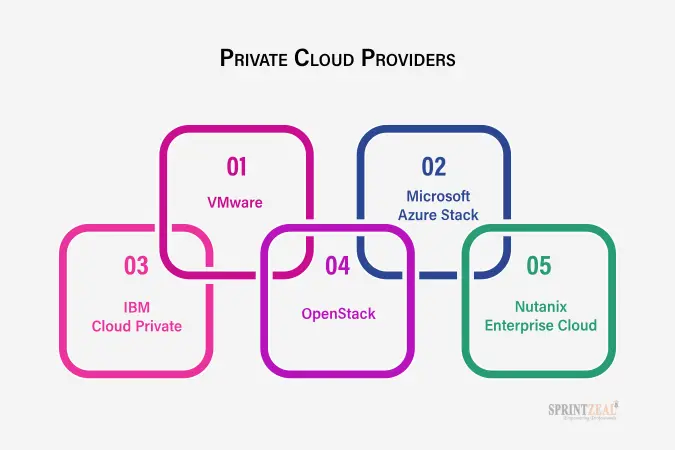
1. VMware
Overview:
VMware is a famous personal cloud company that gives loads of virtualization and cloud computing solutions. Its personal cloud offering, VMware vCloud Suite, lets in businesses to build, manage, and steady their very own personal cloud environments.
Advantages:
Comprehensive virtualization and cloud management tools
Integration with public cloud services for hybrid cloud environments
Highly customizable and scalable
Strong security features
Pricing:
VMware vCloud Suite pricing starts at $3,995 per CPU socket.
2. Microsoft Azure Stack
Overview:
Azure Stack is Microsoft`s non-public cloud offering, which permits customers to create and manipulate their personal Azure-well matched non-public cloud environment. It offers a constant consumer enjoy with the Azure public cloud and permits agencies to run Azure offerings on-premises.
Advantages:
Seamless integration with Azure public cloud services
Consistent user experience across public and private clouds
Comprehensive security and compliance features
High availability and disaster recovery capabilities
Pricing:
Azure Stack pricing starts at $4,860 per physical core per year.
Also Read: What Is Public Cloud? Everything You Need to Know About it
3. Hyperstack Secure Private Cloud
Hyperstack Secure Private Cloud is a single-tenant, dedicated AI cloud for regulated enterprise workloads. It is delivered as a bespoke deployment on segregated infrastructure with predictable performance, controlled access and four deployment models to match how much of the stack you want to manage.
Advantages
Fully isolated and single-tenant infrastructure with no shared tenancy.
Not self-serve. Scoped, designed and commissioned specifically for your organisation.
Four deployment models including Metal Only (you own the full stack), Managed Metal (Hyperstack handles hardware, networking and storage while you handle OS upward), Managed Platform (Hyperstack runs infra and orchestration, you run workloads) or Dedicated Cloud (fully managed end-to-end).
Deterministic performance with dedicated, non-oversubscribed resources for consistent AI training and inference throughput.
Sovereignty options available where required with deployment locations chosen to meet your legal jurisdiction and data residency needs.
RoCE or InfiniBand network fabric options for distributed, multi-node AI workloads and network hardware selected based on scale and performance requirements.
Modular architecture across compute, networking, storage and orchestration, built around how you work, using Kubernetes or SLURM as standard.
Compliance aligned to DORA, UK PRA SS2/21 and EU AI Act with single-tenant isolation and audit traceability.
24/7/365 operations, always-on monitoring and severity-based incident response (scope varies by deployment model).
4. IBM Cloud Private
Overview:
IBM Cloud Private is a personal cloud platform that enables users to build and manage their own cloud environments using IBM’s advanced cloud technology. It offers a container-based infrastructure for running both traditional and cloud-native applications — a flexible solution that can also support the evolving needs of an Android app development company looking to scale securely and efficiently.
Advantages:
Supports both traditional and cloud-native applications
Hybrid cloud capabilities for easy integration with public cloud services
Comprehensive security and compliance features
Integration with IBM Cloud public services
Pricing:
IBM Cloud Private pricing starts at $1,500 per core per year.
5. OpenStack
Overview:
OpenStack is a famous open-supply personal cloud platform that gives quite a few infrastructure-as-a-service (IaaS) equipment for constructing and handling personal cloud environments. It is rather customizable and may be used to create a huge variety of personal cloud solutions.
Advantages:
Highly customizable and flexible
Modular architecture allows for easy integration with third-party technologies
Wide range of automation and orchestration tools
Integration with public cloud services
Pricing:
OpenStack is free and open-source software, but organizations may incur costs for hardware, support, and other related services.
6. Advanced Hosting Private Cloud
Overview:
Advanced Hosting Private Cloud is a private cloud platform built on dedicated bare metal servers with OpenStack-based virtualization and software-defined networking. Among other things, AH offers infrastructure-as-a-service (IaaS) with strict resource isolation, predictable performance, and full control over compute, storage, and network layers.
Advantages:
Dedicated bare metal nodes with guaranteed CPU, RAM, and storage resources
OpenStack (Nova, Neutron, Cinder) for compute orchestration and network segmentation
Support for custom network topologies, VLANs, BGP, and high-bandwidth interconnects
Fixed pricing model without per-core, per-socket, or usage-based licensing
Direct access to infrastructure engineers for design, deployment, and operations
Pricing:
Pricing is based on fixed monthly costs per dedicated node and selected infrastructure components, independent of resource utilization or workload intensity.
7. Nutanix Enterprise Cloud
Overview:
Nutanix Enterprise Cloud is a personal cloud platform that gives a hyper-converged infrastructure (HCI) for constructing and coping with personal cloud environments. For both cloud operators and users of cloud-delivered services and applications, the enterprise cloud offers a reliable, efficient, and seamless experience.
Advantages:
Simplifies infrastructure management and reduces complexity
HCI architecture allows for easy scalability and resource allocation
Multi-cloud support allows for easy integration with public cloud services
Comprehensive automation and orchestration tools
Pricing:
Nutanix Enterprise Cloud pricing starts at $11,000 per node per year.
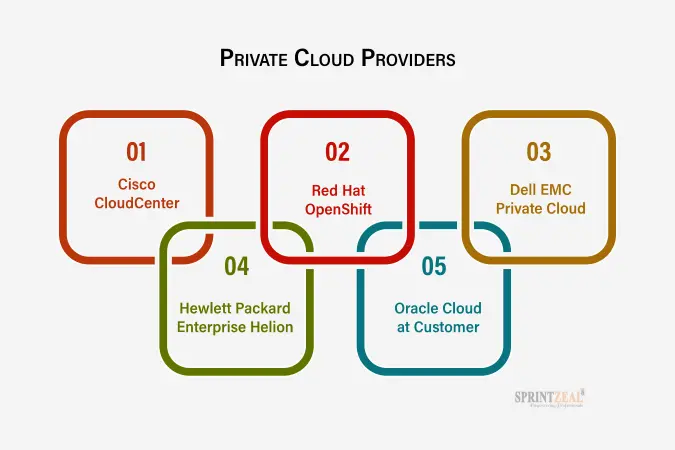
8. Cisco CloudCenter
Overview:
Cisco CloudCenter is a non-public cloud platform that gives a hybrid cloud control solution, permitting agencies to manipulate packages and workloads throughout more than one clouds, each public and non-public. It offers a centralized manage aircraft for dealing with cloud sources and simplifying infrastructure control.
Advantages:
Comprehensive hybrid cloud management tools
Multi-cloud support for easy integration with public cloud services
Self-service portals for users
Built-in security and compliance features
Pricing:
Cisco CloudCenter pricing starts at $3,000 per month.
9. Red Hat OpenShift
Overview:
Red Hat OpenShift is a personal cloud platform that gives a container-primarily based totally infrastructure for constructing and coping with personal cloud environments. It lets in groups to install and manipulate containerized programs throughout a couple of clouds, each public and personal.
Advantages:
Comprehensive container-based infrastructure
Multi-cloud support for easy integration with public cloud services
Automation and orchestration tools
Built-in security and compliance features
Pricing:
Red Hat OpenShift pricing starts at $200 per year.
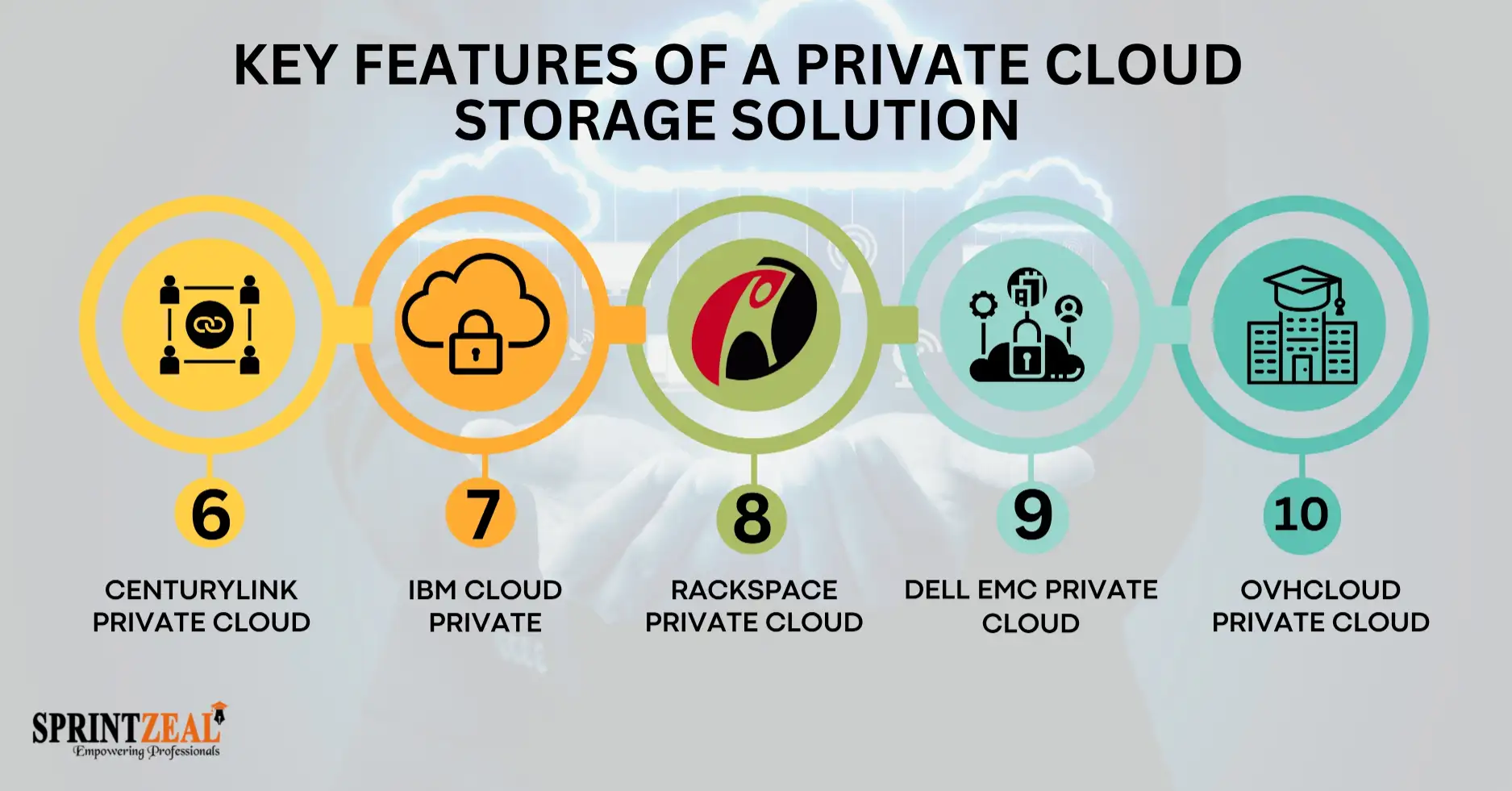
10. Dell EMC Private Cloud
Overview:
Dell EMC Private Cloud is a personal cloud platform that offers a hyper-converged infrastructure (HCI) for constructing and handling personal cloud environments. It combines storage, computing, and networking right into a unmarried platform, simplifying control and decreasing complexity.
Advantages:
Simplifies infrastructure management and reduces complexity
HCI architecture allows for easy scalability and resource allocation
Multi-cloud support allows for easy integration with public cloud services
Comprehensive automation and orchestration tools
Pricing:
Dell EMC Private Cloud pricing varies depending on the specific configuration and features selected.
11. Hewlett Packard Enterprise Helion
Overview:
The personal cloud platform Helion from HPE combines infrastructure-as-a-service (IaaS), platform-as-a-service (PaaS), and software-as-a-service (SaaS) to provide various cloud computing services. It is intended for large-scale private cloud installations in businesses.
Advantages:
Comprehensive range of cloud computing services
Hybrid cloud capabilities for easy integration with public cloud services
Multi-tenant support for efficient resource utilization
Built-in security and compliance features
Pricing:
Hewlett Packard Enterprise Helion pricing varies depending on the specific services and features selected.
12. Oracle Cloud at Customer
Overview:
Oracle Cloud at Customer is a personal cloud platform that lets in companies to run Oracle Cloud offerings of their very own facts centers. It offers the identical talents and functions as Oracle`s public cloud offerings, however with the brought safety and manipulate of a personal cloud environment.
Advantages:
Comprehensive range of cloud services, including database, analytics, and application development
Hybrid cloud capabilities for easy integration with public cloud services
Self-service portals for users
Built-in security and compliance features
Pricing:
Oracle Cloud at Customer pricing varies depending on the specific services and features selected.
13. CenturyLink Private Cloud
Overview:
A private cloud platform known as CenturyLink Private Cloud offers a wide range of cloud computing services, including infrastructure as a service (IaaS), platform as a service (PaaS), and software as a service (SaaS). It is intended for private cloud deployments at an enterprise size.
Advantages:
Comprehensive range of cloud computing services
Multi-cloud support for easy integration with public cloud services
Self-service portals for users
Built-in security and compliance features
Pricing:
CenturyLink Private Cloud pricing varies depending on the specific services and features selected.
14. Hyve Managed Hosting Private Cloud
Overview:
For enterprise-level deployments and hosting critical data, Hyve Managed Hosting offer a robust and customizable private cloud. Through the use of Equinix Smart hands Hyve Managed Hosting are able to offer 100% network up-time and a 20-minute SLA. Every aspect of your private cloud deployment is fully customizable and is monitored by our cloud engineers 24/7/365.
Advantages:
Bespoke private cloud designed for each business’s specific needs
Multi-tenant clouds with logically separated environments are available through Hyve Virtual Private Cloud
Direct-to-engineer, 24/7/365 support
A fully compliant sovereign cloud built on Openshift and VMware Esxi
35+ global locations
Pricing:
Hyve Managed Hosting doesn't offer out of the box pricing, all solutions are bespoke and priced following a free consultation.
15. IBM Cloud Private
Overview:
IBM Cloud Private is a non-public cloud platform that offers a container-primarily based totally infrastructure for constructing and dealing with non-public cloud environments. It permits groups to set up and manipulate containerized packages throughout more than one clouds, each public and non-public.
Comprehensive container-based infrastructure
Multi-cloud support for easy integration with public cloud services
Automation and orchestration tools
Built-in security and compliance features
Pricing:
IBM Cloud Private pricing starts at $2,000 per month.
16. Rackspace Private Cloud
Overview:
A private cloud platform called Rackspace Private Cloud provides software-as-a-service (SaaS), platform-as-a-service (PaaS), and infrastructure-as-a-service (IaaS) among other cloud computing services. It is intended for non-public cloud deployments at enterprise size.
Advantages:
Comprehensive range of cloud computing services
Multi-cloud support - Self-service portals for users
Built-in security and compliance features
Pricing:
Rackspace Private Cloud pricing varies depending on the specific services and features selected.
17. Dell EMC Private Cloud
Overview:
Several cloud computing services, including infrastructure-as-a-service (IaaS), platform-as-a-service (PaaS), and software-as-a-service (SaaS), are offered via the private cloud platform Dell EMC Private Cloud. It is intended for private cloud deployments at an enterprise size.
Advantages:
Comprehensive range of cloud computing services
Multi-cloud support for easy integration with public cloud services
Self-service portals for users
Built-in security and compliance features
Dell EMC Private Cloud pricing varies depending on the specific services and features selected.
18. OVHcloud Private Cloud
Overview:
A personal cloud platform called OVHcloud Private Cloud offers a variety of cloud computing services, such as infrastructure as a service (IaaS), platform as a service (PaaS), and software as a service (SaaS). It is intended for large-scale private cloud installations in businesses.
Advantages:
Comprehensive range of cloud computing services
Multi-cloud support for easy integration with public cloud services
Self-service portals for users
Built-in security and compliance features
Pricing:
OVHcloud Private Cloud pricing varies depending on the specific services and features selected.
Private cloud providers offer stable and scalable cloud solutions for businesses. With international record facilities and offerings, together with digital servers and cloud storage, handling cloud infrastructure is easy. Choose from the pinnacle of 15 carriers to discover the one that fits your commercial enterprise's desires and budget.
Improve your IT infrastructure and move to the cloud today! Learn more about our course, which is suited for cloud computing professionals at and above the entry level. Enroll in our course through the link given below:
- CompTIA Cloud Essentials+ Certification
Are you ready to take your career to the next level? Visit Sprintzeal today and unlock your potential with our industry-leading training and certification courses!
Who provides private cloud?
Private cloud services are offered by providers like VMware, Microsoft Azure Stack, IBM, and OpenStack, offering tailored cloud environments for businesses. Major providers also include Nutanix, HPE, and Oracle.
What is a private cloud service model?
The private cloud is defined as computer services that are only available to a limited number of users rather than the broader public via the Internet or a private internal network.
What are the main features of a private cloud?
Compared to public cloud systems, the private cloud provides scalability, control, and flexibility, which makes it perfect for companies with stringent compliance or data protection requirements.
How is a private cloud different from a public cloud?
Whereas a public cloud is shared by numerous customers and provides scalability and cost-effectiveness, a private cloud is devoted to a single company and offers more control and protection.
The rapid expansion of cloud computing has prompted businesses to increasingly turn to Private Cloud Providers with notable urgency. Acknowledged for their exceptional security, adaptability, and unmatched scalability, these providers have garnered favor among discerning business leaders. Many organizations are now also adopting Virtual
Private Cloud (VPC) solutions to enjoy the benefits of a secure cloud environment while maintaining flexibility in resource allocation. To understand how private cloud differs from other models like public or hybrid, check out this detailed comparison of On Premise vs Cloud environments.
To effectively communicate these complex architecture choices, IT and marketing leaders use Flipsnack pitch deck online maker to present security benefits and technical ROI to executive stakeholders for final approval.
Private Cloud Providers leverage state-of-the-art data centers and advanced cloud services to facilitate seamless transitions to the cloud for companies of all sizes.
These providers ensure better uptime, enhanced security, and optimized speed for Magento-based websites, with Magento 2 Hosting solutions designed to meet the unique demands of large-scale online stores. In parallel with infrastructure adoption, many organizations invest in cloud software development to fully utilize private cloud capabilities. Custom applications built for private environments allow tighter integration with legacy systems, advanced workload orchestration, and enhanced data governance.
This article delves into the manifold benefits of aligning with a Private Cloud Server Provider and presents a curated list of the top 15+ transformative offerings available in the market. Selecting the appropriate provider is fundamental to the success of any business endeavour, regardless of its scale or complexity.
A private cloud is a type of virtualized hosting infrastructure that allows for operating data processes and applications using network, storage, and computing resources; however, they are not shared by other organizations. Managed remote server on-premise, or a virtual machine.

Compliance is only part of the picture, though. Organizations with mature cloud financial management practices typically realize cost savings of 20-30% over those handling resource governance on the fly. Many leading providers also adopt ISO 27001 solutions to establish a globally recognized framework for managing data security and ensuring continuous risk assessment.
Also Read: Types of Cloud Computing Explained
Private cloud computing offers businesses the advantages of cloud computing while affording them greater control over their infrastructure and data. However, selecting the right private cloud provider can be a challenging task. That's why our comprehensive guide is here to help. We've meticulously curated a list of the top 15+ private cloud providers, complete with detailed information on their features, pricing structures, as well as the advantages and disadvantages of each. Whether your organization is large or small, our guide will assist you in finding the ideal private cloud provider that perfectly aligns with your specific requirements and preferences.
Overview:
VMware is a famous personal cloud company that gives loads of virtualization and cloud computing solutions. Its personal cloud offering, VMware vCloud Suite, lets in businesses to build, manage, and steady their very own personal cloud environments.
Advantages:
Pricing:
VMware vCloud Suite pricing starts at $3,995 per CPU socket.
Overview:
Azure Stack is Microsoft`s non-public cloud offering, which permits customers to create and manipulate their personal Azure-well matched non-public cloud environment. It offers a constant consumer enjoy with the Azure public cloud and permits agencies to run Azure offerings on-premises.
Advantages:
Pricing:
Azure Stack pricing starts at $4,860 per physical core per year.
Also Read: What Is Public Cloud? Everything You Need to Know About it
Hyperstack Secure Private Cloud is a single-tenant, dedicated AI cloud for regulated enterprise workloads. It is delivered as a bespoke deployment on segregated infrastructure with predictable performance, controlled access and four deployment models to match how much of the stack you want to manage.
Advantages
Four deployment models including Metal Only (you own the full stack), Managed Metal (Hyperstack handles hardware, networking and storage while you handle OS upward), Managed Platform (Hyperstack runs infra and orchestration, you run workloads) or Dedicated Cloud (fully managed end-to-end).
Overview:
IBM Cloud Private is a personal cloud platform that enables users to build and manage their own cloud environments using IBM’s advanced cloud technology. It offers a container-based infrastructure for running both traditional and cloud-native applications — a flexible solution that can also support the evolving needs of an Android app development company looking to scale securely and efficiently.
Advantages:
Pricing:
IBM Cloud Private pricing starts at $1,500 per core per year.
Overview:
OpenStack is a famous open-supply personal cloud platform that gives quite a few infrastructure-as-a-service (IaaS) equipment for constructing and handling personal cloud environments. It is rather customizable and may be used to create a huge variety of personal cloud solutions.
Advantages:
Pricing:
OpenStack is free and open-source software, but organizations may incur costs for hardware, support, and other related services.
Overview:
Advanced Hosting Private Cloud is a private cloud platform built on dedicated bare metal servers with OpenStack-based virtualization and software-defined networking. Among other things, AH offers infrastructure-as-a-service (IaaS) with strict resource isolation, predictable performance, and full control over compute, storage, and network layers.
Advantages:
Pricing:
Pricing is based on fixed monthly costs per dedicated node and selected infrastructure components, independent of resource utilization or workload intensity.
Overview:
Nutanix Enterprise Cloud is a personal cloud platform that gives a hyper-converged infrastructure (HCI) for constructing and coping with personal cloud environments. For both cloud operators and users of cloud-delivered services and applications, the enterprise cloud offers a reliable, efficient, and seamless experience.
Advantages:
Pricing:
Nutanix Enterprise Cloud pricing starts at $11,000 per node per year.
Overview:
Cisco CloudCenter is a non-public cloud platform that gives a hybrid cloud control solution, permitting agencies to manipulate packages and workloads throughout more than one clouds, each public and non-public. It offers a centralized manage aircraft for dealing with cloud sources and simplifying infrastructure control.
Advantages:
Pricing:
Cisco CloudCenter pricing starts at $3,000 per month.
Overview:
Red Hat OpenShift is a personal cloud platform that gives a container-primarily based totally infrastructure for constructing and coping with personal cloud environments. It lets in groups to install and manipulate containerized programs throughout a couple of clouds, each public and personal.
Advantages:
Pricing:
Red Hat OpenShift pricing starts at $200 per year.
Overview:
Dell EMC Private Cloud is a personal cloud platform that offers a hyper-converged infrastructure (HCI) for constructing and handling personal cloud environments. It combines storage, computing, and networking right into a unmarried platform, simplifying control and decreasing complexity.
Advantages:
Pricing:
Dell EMC Private Cloud pricing varies depending on the specific configuration and features selected.
Overview:
The personal cloud platform Helion from HPE combines infrastructure-as-a-service (IaaS), platform-as-a-service (PaaS), and software-as-a-service (SaaS) to provide various cloud computing services. It is intended for large-scale private cloud installations in businesses.
Advantages:
Pricing:
Hewlett Packard Enterprise Helion pricing varies depending on the specific services and features selected.
Overview:
Oracle Cloud at Customer is a personal cloud platform that lets in companies to run Oracle Cloud offerings of their very own facts centers. It offers the identical talents and functions as Oracle`s public cloud offerings, however with the brought safety and manipulate of a personal cloud environment.
Advantages:
Pricing:
Oracle Cloud at Customer pricing varies depending on the specific services and features selected.
Overview:
A private cloud platform known as CenturyLink Private Cloud offers a wide range of cloud computing services, including infrastructure as a service (IaaS), platform as a service (PaaS), and software as a service (SaaS). It is intended for private cloud deployments at an enterprise size.
Advantages:
Pricing:
CenturyLink Private Cloud pricing varies depending on the specific services and features selected.
Overview:
For enterprise-level deployments and hosting critical data, Hyve Managed Hosting offer a robust and customizable private cloud. Through the use of Equinix Smart hands Hyve Managed Hosting are able to offer 100% network up-time and a 20-minute SLA. Every aspect of your private cloud deployment is fully customizable and is monitored by our cloud engineers 24/7/365.
Advantages:
Pricing:
Hyve Managed Hosting doesn't offer out of the box pricing, all solutions are bespoke and priced following a free consultation.
Overview:
IBM Cloud Private is a non-public cloud platform that offers a container-primarily based totally infrastructure for constructing and dealing with non-public cloud environments. It permits groups to set up and manipulate containerized packages throughout more than one clouds, each public and non-public.
Pricing:
IBM Cloud Private pricing starts at $2,000 per month.
Overview:
A private cloud platform called Rackspace Private Cloud provides software-as-a-service (SaaS), platform-as-a-service (PaaS), and infrastructure-as-a-service (IaaS) among other cloud computing services. It is intended for non-public cloud deployments at enterprise size.
Advantages:
Pricing:
Rackspace Private Cloud pricing varies depending on the specific services and features selected.
Overview:
Several cloud computing services, including infrastructure-as-a-service (IaaS), platform-as-a-service (PaaS), and software-as-a-service (SaaS), are offered via the private cloud platform Dell EMC Private Cloud. It is intended for private cloud deployments at an enterprise size.
Advantages:
Dell EMC Private Cloud pricing varies depending on the specific services and features selected.
Overview:
A personal cloud platform called OVHcloud Private Cloud offers a variety of cloud computing services, such as infrastructure as a service (IaaS), platform as a service (PaaS), and software as a service (SaaS). It is intended for large-scale private cloud installations in businesses.
Advantages:
Pricing:
OVHcloud Private Cloud pricing varies depending on the specific services and features selected.
Private cloud providers offer stable and scalable cloud solutions for businesses. With international record facilities and offerings, together with digital servers and cloud storage, handling cloud infrastructure is easy. Choose from the pinnacle of 15 carriers to discover the one that fits your commercial enterprise's desires and budget.
Improve your IT infrastructure and move to the cloud today! Learn more about our course, which is suited for cloud computing professionals at and above the entry level. Enroll in our course through the link given below:
- CompTIA Cloud Essentials+ Certification
Are you ready to take your career to the next level? Visit Sprintzeal today and unlock your potential with our industry-leading training and certification courses!
Who provides private cloud?
Private cloud services are offered by providers like VMware, Microsoft Azure Stack, IBM, and OpenStack, offering tailored cloud environments for businesses. Major providers also include Nutanix, HPE, and Oracle.
What is a private cloud service model?
The private cloud is defined as computer services that are only available to a limited number of users rather than the broader public via the Internet or a private internal network.
What are the main features of a private cloud?
Compared to public cloud systems, the private cloud provides scalability, control, and flexibility, which makes it perfect for companies with stringent compliance or data protection requirements.
How is a private cloud different from a public cloud?
Whereas a public cloud is shared by numerous customers and provides scalability and cost-effectiveness, a private cloud is devoted to a single company and offers more control and protection.


Sprintzeal
Tue, 25 February 2025
Mon, 31 March 2025

Tue, 25 February 2025

© 2024 Sprintzeal Americas Inc. - All Rights Reserved.

 USA : +1315-322-7821
 UK : +44 7700 174870
 IND : +919008230179
 AUS : +61 480 005 455
Leave a comment