Network Analyst: How to Become, Skills and Career Guide
Wed, 29 January 2025

Severity: Warning
Message: file_get_contents(http://www.geoplugin.net/json.gp?ip=216.73.216.239): Failed to open stream: HTTP request failed! HTTP/1.1 403 Forbidden
Filename: helpers/location_helper.php
Line Number: 77
Backtrace:
File: /home/sprintzeal.org/public_html/application/helpers/location_helper.php
Line: 77
Function: file_get_contents
File: /home/sprintzeal.org/public_html/application/controllers/Blog.php
Line: 109
Function: location_details
File: /home/sprintzeal.org/public_html/index.php
Line: 289
Function: require_once
Follow the stories of academics and their research expeditions

Now that you are here, you might already know what project management is. To put it simply, Project Management is a method, process, or study that is used to effectively accomplish the goals and objectives of a project by leading the team within the constraints.
Project management basically deals with multiple concepts such as product planning, cost management, time management, and other such concepts to provide a successful result. This practice enables project managers to keep up with all the project milestones given, along with delivering all project aspects.
Time Management in Project Management is one of the most important concepts to put into practice for delivering absolute business value to customers. With proper practice with project deliverables, every project manager can have access to format and process any project deliverable as per the stakeholder’s requirements.
"Time management" is a well-known term in all technical business domains, and it is highly necessary for project management activities in every organization. The versatility that time management provides with planning, scheduling, monitoring, and controlling project tasks and activities comes from the project time management tools that can be used.
Why is Time management in project management so important? You may wonder:
A project in any instance would always have a deadline, as in an official finish date. To ensure that the project milestones are met, each project must be organized and tasks must be scheduled in order to effectively manage the team's time and meet the deadline. To ensure this happens, project managers practice time management to provide an effective working schedule that meets the deadline.

Working on a project means making full use of the limited time offered by the project milestones. With lack for time, there also comes a risk in delivering the project on or before deadline. This is where time management comes into the picture.
As summed up previously, time management is one of the project management processes that analyze project tasks and activities to develop a schedule or a timeline to make sure that all project tasks meet the scheduled deadline. The following are a few steps that help you implement time management in project management to strategically schedule all project tasks to meet the deadline.
Planning a project entails not only planning the resources but also planning the tasks in relation to the time frame. By creating a project plan, a project manager is now providing a detailed schedule of activities and tasks to be performed within the available resources.
A project plan outlines all the project objectives, which in turn provides a reference point to the project team, the company, and the stakeholders. By designing a thorough plan, a lot of time would be saved by cutting down on team members' efforts in understanding the complexity of project tasks and hindrances.
Refer: How to create an effective project plan
Defining project activities requires identifying the tasks, which can be done using a work breakdown structure process. What is a work breakdown structure? WBS is a method used in project management to break down all project tasks and deliverables and list them hierarchically.
How do I create a work breakdown structure? First, to create a WBS for your project, you must first understand in what format you desire to represent your breakdown structure. There are some easy formats to present a WBS, such as Chart format, Tabular format, Hierarchical structure, Outline structure, and the WBS dictionary. After you choose your desired format, all you have to do is follow some simple steps.
Refer: How to create a work breakdown structure
Structuring of tasks becomes easy when you derive all the project tasks and know the hierarchy. With this, it becomes easy to identify project tasks and determine their dependencies. Using a network diagram will help in the illustration of logical and sequential connections across the project tasks.
A note to remember: Structuring of tasks with their dependencies must not be assigned with respect to the time or the due dates, but instead, you have to focus on the order of project tasks that are to be completed. This makes sure that the project workflow is sustained and the project is delivered efficiently.
Assigning Resources becomes easy once you have an idea of which tasks to prioritize. Right after deciding the hierarchy of the tasks, you have to estimate and distribute the resources accordingly. To do so, you would also require identifying the right type of resource and the right amount of resource that would be required for each task to be completed.
Assigning time can be a completely different task when compared to assigning other resources like software tools, materials, and budget. Assigning time to the tasks takes a considerable amount of time and thought to first understand and then schedule. Using the Program Evolution Review Technique (PERT) tool in project management helps project managers design and organize project tasks.
Now that all the resources have been distributed, there’s just one final job left to take care of.
Scheduling project tasks is the only task now remaining after defining and structuring the project tasks. Now that the resources are well distributed, considering the deadline for the project, the tasks and activities can be scheduled based on the hierarchy of the tasks and the availability of resources.
To be more efficient at managing such project management tasks, project managers must be aware of project scheduling tools. Such tools help in visually representing the tasks, the resources assigned, and the deadline provided for each task.
Controlling the schedule also includes developing a strategy that can effectively keep up with the planned schedule. This ensures that the deliverables are completed on time and within the specified milestones.
Since project tasks must be constantly monitored and reviewed to update the work progress, controlling the schedule enables you to see through the errors. It also enables you to track the areas where the project is falling behind schedule and makes sure you keep up with the deadlines.
After discussing the importance of time management in project management, you may have realized how time management can affect the quality and performance of project activities and task outcomes. The application and implementation of time management also provide some good advantages.
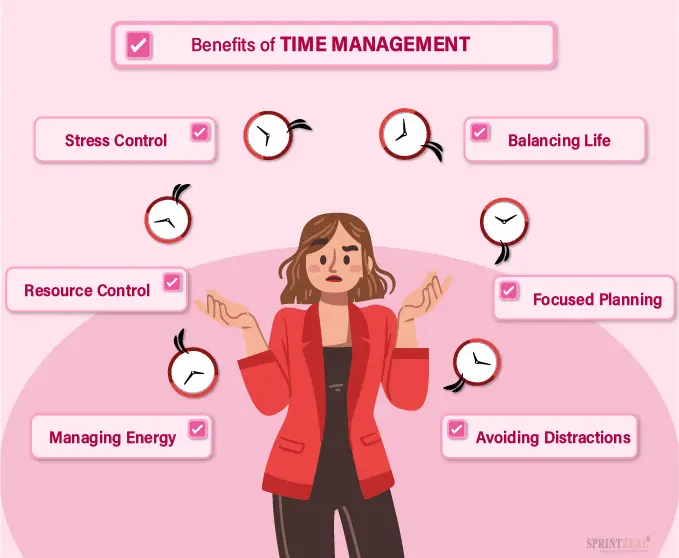
As we all know, having a basic understanding of time management allows us to complete tasks by clearly optimizing and managing time. This in turn saves more time for other tasks or activities.
To go into more detail, here are some of the most beneficial advantages of project time management:
– Stress Control is one of the best benefits that time management can provide. It helps reduce stress since you have an idea of when the tasks are being performed. All you have to do is track the progress. Additionally, increasing confidence and reducing anxiety
– Balancing Life with time management aids in balancing work and personal life, since time management in project management saves more time for other chores. By allowing you to keep performing tasks productively by prioritizing tasks and activities accordingly, it also allows you to have control over your daily schedule.
– Focused Planning your day-to-day work life is as important as delivering deliverables. By designing a systematic time management plan, the possibility for mistakes to happen would be reduced. Planning also helps reduce procrastination and avoid last-minute rushing.
– Avoiding Distractions is another of the most beneficial benefits of practicing time management. When time management is effectively designed, it easily eliminates distractions and boosts concentration since there is a certain amount of time dedicated to every single task and activity, including breaks.
– Managing Energy is by far one of the most valuable advantages of managing time. Instead of working harder, you work smarter by managing your time accordingly. This, in turn, helps you develop focus, allowing you to work more productively for longer periods of time. On the other hand, when you lose focus, procrastinating will become easy.
– Resource Control is not only about saving time for future projects but also staying within budget. As the key term says, "Money is Time, Time is Money."
After all the discussion, it concludes that, project time management is one of the most essential skills that every project manager must practice. By7 this, project managers help both the organization and its employees to not just save time for other activities but also to stay consistent in the market.
As important as it might seem, managing time alters the course of action, irrespective of any type of project. Hence it is important to practice timed management not just to save time but to also smartly control the project budget as well.
Simple steps to implement time management in project management is to first plan, then define, and then structure the project tasks. The following steps involve assigning resources, scheduling tasks and activities, and controlling schedule.
Time management also benefits with some important assets such as Stress Control, Balanced Life, Focused Planning, Avoiding Distractions, Energy Management, and Control Resource.

Become professionally certified right away by studying Project Management techniques with our top-notch Training Professionals. Enroll in our PMP certification training program.
Do visit Sprintzeal’s all courses page to explore more professional certification training courses. Reach out to us or request a callback for any further detailed inquiry about the course or for any related queries.
Now that you are here, you might already know what project management is. To put it simply, Project Management is a method, process, or study that is used to effectively accomplish the goals and objectives of a project by leading the team within the constraints.
Project management basically deals with multiple concepts such as product planning, cost management, time management, and other such concepts to provide a successful result. This practice enables project managers to keep up with all the project milestones given, along with delivering all project aspects.
Time Management in Project Management is one of the most important concepts to put into practice for delivering absolute business value to customers. With proper practice with project deliverables, every project manager can have access to format and process any project deliverable as per the stakeholder’s requirements.
"Time management" is a well-known term in all technical business domains, and it is highly necessary for project management activities in every organization. The versatility that time management provides with planning, scheduling, monitoring, and controlling project tasks and activities comes from the project time management tools that can be used.
Why is Time management in project management so important? You may wonder:
A project in any instance would always have a deadline, as in an official finish date. To ensure that the project milestones are met, each project must be organized and tasks must be scheduled in order to effectively manage the team's time and meet the deadline. To ensure this happens, project managers practice time management to provide an effective working schedule that meets the deadline.
Working on a project means making full use of the limited time offered by the project milestones. With lack for time, there also comes a risk in delivering the project on or before deadline. This is where time management comes into the picture.
As summed up previously, time management is one of the project management processes that analyze project tasks and activities to develop a schedule or a timeline to make sure that all project tasks meet the scheduled deadline. The following are a few steps that help you implement time management in project management to strategically schedule all project tasks to meet the deadline.
Planning a project entails not only planning the resources but also planning the tasks in relation to the time frame. By creating a project plan, a project manager is now providing a detailed schedule of activities and tasks to be performed within the available resources.
A project plan outlines all the project objectives, which in turn provides a reference point to the project team, the company, and the stakeholders. By designing a thorough plan, a lot of time would be saved by cutting down on team members' efforts in understanding the complexity of project tasks and hindrances.
Refer: How to create an effective project plan
Defining project activities requires identifying the tasks, which can be done using a work breakdown structure process. What is a work breakdown structure? WBS is a method used in project management to break down all project tasks and deliverables and list them hierarchically.
How do I create a work breakdown structure? First, to create a WBS for your project, you must first understand in what format you desire to represent your breakdown structure. There are some easy formats to present a WBS, such as Chart format, Tabular format, Hierarchical structure, Outline structure, and the WBS dictionary. After you choose your desired format, all you have to do is follow some simple steps.
Refer: How to create a work breakdown structure
Structuring of tasks becomes easy when you derive all the project tasks and know the hierarchy. With this, it becomes easy to identify project tasks and determine their dependencies. Using a network diagram will help in the illustration of logical and sequential connections across the project tasks.
A note to remember: Structuring of tasks with their dependencies must not be assigned with respect to the time or the due dates, but instead, you have to focus on the order of project tasks that are to be completed. This makes sure that the project workflow is sustained and the project is delivered efficiently.
Assigning Resources becomes easy once you have an idea of which tasks to prioritize. Right after deciding the hierarchy of the tasks, you have to estimate and distribute the resources accordingly. To do so, you would also require identifying the right type of resource and the right amount of resource that would be required for each task to be completed.
Assigning time can be a completely different task when compared to assigning other resources like software tools, materials, and budget. Assigning time to the tasks takes a considerable amount of time and thought to first understand and then schedule. Using the Program Evolution Review Technique (PERT) tool in project management helps project managers design and organize project tasks.
Now that all the resources have been distributed, there’s just one final job left to take care of.
Scheduling project tasks is the only task now remaining after defining and structuring the project tasks. Now that the resources are well distributed, considering the deadline for the project, the tasks and activities can be scheduled based on the hierarchy of the tasks and the availability of resources.
To be more efficient at managing such project management tasks, project managers must be aware of project scheduling tools. Such tools help in visually representing the tasks, the resources assigned, and the deadline provided for each task.
Controlling the schedule also includes developing a strategy that can effectively keep up with the planned schedule. This ensures that the deliverables are completed on time and within the specified milestones.
Since project tasks must be constantly monitored and reviewed to update the work progress, controlling the schedule enables you to see through the errors. It also enables you to track the areas where the project is falling behind schedule and makes sure you keep up with the deadlines.
After discussing the importance of time management in project management, you may have realized how time management can affect the quality and performance of project activities and task outcomes. The application and implementation of time management also provide some good advantages.
As we all know, having a basic understanding of time management allows us to complete tasks by clearly optimizing and managing time. This in turn saves more time for other tasks or activities.
To go into more detail, here are some of the most beneficial advantages of project time management:
– Stress Control is one of the best benefits that time management can provide. It helps reduce stress since you have an idea of when the tasks are being performed. All you have to do is track the progress. Additionally, increasing confidence and reducing anxiety
– Balancing Life with time management aids in balancing work and personal life, since time management in project management saves more time for other chores. By allowing you to keep performing tasks productively by prioritizing tasks and activities accordingly, it also allows you to have control over your daily schedule.
– Focused Planning your day-to-day work life is as important as delivering deliverables. By designing a systematic time management plan, the possibility for mistakes to happen would be reduced. Planning also helps reduce procrastination and avoid last-minute rushing.
– Avoiding Distractions is another of the most beneficial benefits of practicing time management. When time management is effectively designed, it easily eliminates distractions and boosts concentration since there is a certain amount of time dedicated to every single task and activity, including breaks.
– Managing Energy is by far one of the most valuable advantages of managing time. Instead of working harder, you work smarter by managing your time accordingly. This, in turn, helps you develop focus, allowing you to work more productively for longer periods of time. On the other hand, when you lose focus, procrastinating will become easy.
– Resource Control is not only about saving time for future projects but also staying within budget. As the key term says, "Money is Time, Time is Money."
After all the discussion, it concludes that, project time management is one of the most essential skills that every project manager must practice. By7 this, project managers help both the organization and its employees to not just save time for other activities but also to stay consistent in the market.
As important as it might seem, managing time alters the course of action, irrespective of any type of project. Hence it is important to practice timed management not just to save time but to also smartly control the project budget as well.
Simple steps to implement time management in project management is to first plan, then define, and then structure the project tasks. The following steps involve assigning resources, scheduling tasks and activities, and controlling schedule.
Time management also benefits with some important assets such as Stress Control, Balanced Life, Focused Planning, Avoiding Distractions, Energy Management, and Control Resource.
Become professionally certified right away by studying Project Management techniques with our top-notch Training Professionals. Enroll in our PMP certification training program.
Do visit Sprintzeal’s all courses page to explore more professional certification training courses. Reach out to us or request a callback for any further detailed inquiry about the course or for any related queries.

Sushmith T
Our technical content writer, Sushmith, is an experienced writer, creating articles and content for websites, specializing in the areas of training programs and educational content. His writings are mainly concerned with the most major developments in specialized certification and training, e-learning, and other significant areas in the field of education.
Wed, 29 January 2025
Wed, 29 January 2025
Tue, 25 February 2025


© 2024 Sprintzeal Americas Inc. - All Rights Reserved.

 USA : +1315-322-7821
 UK : +44 7700 174870
 IND : +919008230179
 AUS : +61 480 005 455
Leave a comment