Customer Experience (CX): Definition, Importance, and Strategies for Success
Tue, 25 February 2025

Follow the stories of academics and their research expeditions

Splunk is a high-performance, scalable software server written in programming languages that indexes, monitors, search logs, and examines machine-generated data, big data, and other IT data in real time through a web user interface or web applications.
In real-time, the software is a big data solution that captures, indexes, and corresponds to the current data in a searchable container and provides parallelism.
It produces reports, graphs, alerts, dashboards, and visualizations with updated information on the log.
The best advantages of Splunk are,
- It creates machine-driven big data beneficial over an enterprise or organization to identify data patterns, detect problems, and provide reasoning for operational conduct with metrics.
- A technology perfect for managing applications, security purposes, compliance, and especially for business and defined web analytics.
- It works with data generated by any web server, application, or device.
- Interconnect with the system directory.
- Access updated log information.
- Examine logs files brought by the devices and systems
On having a slight breakdown on ‘‘what is Splunk tool’, this article sheds more light on the overview of Splunk, the types of data Splunk can read, and features important for application management, security, compliance, and for business and web analytics.
Splunk is a high-performance data platform, advanced, scalable software that indexes, searches logs, and other big data stored in applications and systems.
This software server boosts the enterprise state of being observable, merges security, and allows uncountable custom applications in dynamic multiple environments.
With Splunk software, searching for a piece of data in a pool of complex data becomes quicker to access. To identify configuration file issues and detect current configuration which is running becomes hectic, that is Splunk utilization comes into play in log files.
That said again, a question might go on to what is Splunk software? So, Splunk can index any machine data without having the need for any database to actually store it. That means it simply and smartly data stores by making use of its indexes. This is the biggest advantage.

Such a digitized platform's common data sources are IT operations, database services, Microsoft infrastructure, structured data, web services, cloud, network security, virtualization, and more. Now that the growth in IT advancement and machines are challenging each day in digital work, it gives enough reasons why not to apply for Splunk.
There are various ways to use Splunk that is as Splunk enterprise, Splunk cloud, and Splunk light. But, there are limitations with Splunk light in comparison with cloud and enterprise with a number of users, storage, HA & DR, clustering, and segregated search. Often the need of understanding what is the main use of Splunk? Well, developers generally use Splunk step-wise,
1st step: Accelerate development and analyze testing.
2nd step: This process initiates to secure and implies integrating with the IT infrastructure.
3rd step: Lastly build a real-time data application.
The tool offers a good number of advantages for an enterprise, organization, or business to monitor, report, and analyze security information, an event management tool, and others. It just does not gather beneficial machine-generated data and change it into compelling operational intelligence but transfers details with the help of charts, reports, and alerts for improving performance.
Suggested Read; Big Data Guide 2022
In context and improvising with SDKs, UI, and API, Splunk quite make a good difference which;
- Power mobile applications with Key Performance Indicators (KPIs) and alerts to gauge a company's overall long-term performance.
- Gives flexible remote logging. Users can log directly to Splunk from remote devices.
- Take out Splunk data for long-term storage warehousing
- User-defined dashboards with customer-specific data
- Integrate data cleaning or data parsing, data on-boarding, and dashboard creation into Splunk with your BI tools
- Run Splunk searches and display results in smart mode from within your application
Splunk features cater to quick solutions for handling data in the most effective manner. The features allow reporting, log analysis, monitoring, altering, and dashboards.
To bring about the software features; this tool attributes accelerate development & testing, help builds data applications in real-time, achieve ROI faster, agile statistics, real-time architecture report, searches, analysis, visualize and report your whole IT infrastructure to empower users, and accelerate business data advanced level.
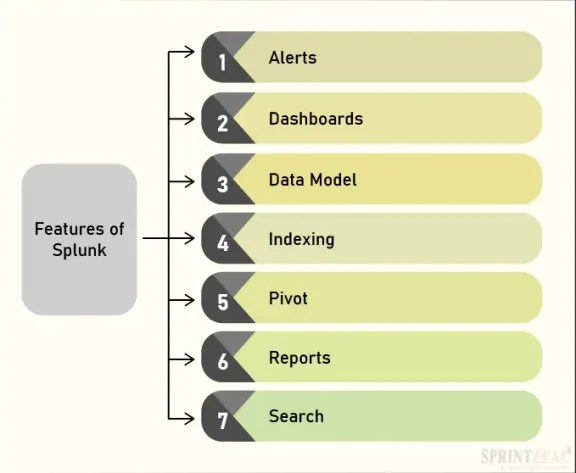
The other important main features of Splunk are:
Indexing: it indexes machine data into events and puts down the results in the index.
Data model: a hierarchically-structured dataset of an enterprise with visual representations.
Pivot: dashboard panel to give data visualization using the pivot editor
Search: Allows primary navigation of data and report on search results
Alerts: A saved search that triggers conditions to achieve results that met user-defined conditions.
Reports: Saved searches and pivots that display statistics and visualizations of events.
Dashboards: Workflows panels that contain a variety of modules or data customizable. For example; Search boxes, charts, tables, fields, and lists.
Versions of Splunk Products
Splunk is available in three various versions.
- Splunk Cloud
- Splunk Enterprise
- Splunk Light
A Splunk architecture is distributed search architecture with components of a search head, indexer, forwarder, standalone deployment, distributed deployment, and clustered deployment that allows handling large data volumes.
To under the architecture, understanding what Splunk comes first. As we know, Splunk is a distributed system that parses, aggregates, and analyzes log data.
With the help of Splunk Architecture, it allows running scripts, communicates and monitors with log files, searches the events, visualizes, and listens on network ports.
Here is a representation of the Splunk architecture and its components in the following figure.

Popular companies that rely on Splunk applications are:
- Adobe
- Adidas
- Bosch
- Cisco
- IBM
- Motorola
- PepsiCo
- Salesforce
- Visa
- Walmart

As previously discussed, we know now what is Splunk used for. On a daily basis of data and networking, managing large data is overwhelming with traditional technology. Needless to mention how the IT infrastructure and its machines are advancing, a digitized platform like Splunk assists and resolves a worthwhile solution in accessing valuable data in dynamic situations.
Candidates interested in training and certifications to elevate their careers, can explore all courses offered by Sprintzeal and request a demo trial.
For more career-oriented courses training and certification-related details, you can reach us at Click Here or chat with our course expert.
We also offer other popular training courses like:
Big Data Hadoop Certification Training Course
CompTIA Data+ Certification Training
What is Splunk used for?
Splunk monitors and searches via big data, that indexes and corresponds information in a container to make it accessible to create alerts, reports, and ideation.
Is Splunk a tool or software?
Splunk is a software platform mainly in use to analyze, monitor, visualize, and search the machine-generated data in real-time collected from websites, applications, devices, etc.
The software ensures organizations are safeguarded, flexible and advanced that empowers any IT infrastructure, enterprise, and business.
Is Splunk a database?
Splunk is a database system designed for collecting structure and analyzing machine-generated data but refrain from using any databases. In fact, it makes use of its indexes from other databases web servers, sensors, networks, etc., to provide better analysis and services.
What language is Splunk written in?
Splunk is written in languages like C/C++ and Python.
Who should learn Splunk?
Learners and professionals like Analysts, Administrators, Developers, Architects, SREs, etc., can utilize Splunk to accurately analyze data.
Splunk is a high-performance, scalable software server written in programming languages that indexes, monitors, search logs, and examines machine-generated data, big data, and other IT data in real time through a web user interface or web applications.
In real-time, the software is a big data solution that captures, indexes, and corresponds to the current data in a searchable container and provides parallelism.
It produces reports, graphs, alerts, dashboards, and visualizations with updated information on the log.
The best advantages of Splunk are,
- It creates machine-driven big data beneficial over an enterprise or organization to identify data patterns, detect problems, and provide reasoning for operational conduct with metrics.
- A technology perfect for managing applications, security purposes, compliance, and especially for business and defined web analytics.
- It works with data generated by any web server, application, or device.
- Interconnect with the system directory.
- Access updated log information.
- Examine logs files brought by the devices and systems
On having a slight breakdown on ‘‘what is Splunk tool’, this article sheds more light on the overview of Splunk, the types of data Splunk can read, and features important for application management, security, compliance, and for business and web analytics.
Splunk is a high-performance data platform, advanced, scalable software that indexes, searches logs, and other big data stored in applications and systems.
This software server boosts the enterprise state of being observable, merges security, and allows uncountable custom applications in dynamic multiple environments.
With Splunk software, searching for a piece of data in a pool of complex data becomes quicker to access. To identify configuration file issues and detect current configuration which is running becomes hectic, that is Splunk utilization comes into play in log files.
That said again, a question might go on to what is Splunk software? So, Splunk can index any machine data without having the need for any database to actually store it. That means it simply and smartly data stores by making use of its indexes. This is the biggest advantage.
Such a digitized platform's common data sources are IT operations, database services, Microsoft infrastructure, structured data, web services, cloud, network security, virtualization, and more. Now that the growth in IT advancement and machines are challenging each day in digital work, it gives enough reasons why not to apply for Splunk.
There are various ways to use Splunk that is as Splunk enterprise, Splunk cloud, and Splunk light. But, there are limitations with Splunk light in comparison with cloud and enterprise with a number of users, storage, HA & DR, clustering, and segregated search. Often the need of understanding what is the main use of Splunk? Well, developers generally use Splunk step-wise,
1st step: Accelerate development and analyze testing.
2nd step: This process initiates to secure and implies integrating with the IT infrastructure.
3rd step: Lastly build a real-time data application.
The tool offers a good number of advantages for an enterprise, organization, or business to monitor, report, and analyze security information, an event management tool, and others. It just does not gather beneficial machine-generated data and change it into compelling operational intelligence but transfers details with the help of charts, reports, and alerts for improving performance.
Suggested Read; Big Data Guide 2022
In context and improvising with SDKs, UI, and API, Splunk quite make a good difference which;
- Power mobile applications with Key Performance Indicators (KPIs) and alerts to gauge a company's overall long-term performance.
- Gives flexible remote logging. Users can log directly to Splunk from remote devices.
- Take out Splunk data for long-term storage warehousing.
- User-defined dashboards with customer-specific data.
- Integrate data cleaning or data parsing, data on-boarding, and dashboard creation into Splunk with your BI tools.
- Run Splunk searches and display results in smart mode from within your application.
Splunk features cater to quick solutions for handling data in the most effective manner. The features allow reporting, log analysis, monitoring, altering, and dashboards.
To bring about the software features; this tool attributes accelerate development & testing, help builds data applications in real-time, achieve ROI faster, agile statistics, real-time architecture report, searches, analysis, visualize and report your whole IT infrastructure to empower users, and accelerate business data advanced level.
The other important main features of Splunk are:
Indexing: it indexes machine data into events and puts down the results in the index.
Data model: a hierarchically-structured dataset of an enterprise with visual representations.
Pivot: dashboard panel to give data visualization using the pivot editor
Search: Allows primary navigation of data and report on search results
Alerts: A saved search that triggers conditions to achieve results that met user-defined conditions.
Reports: Saved searches and pivots that display statistics and visualizations of events.
Dashboards: Workflows panels that contain a variety of modules or data customizable. For example; Search boxes, charts, tables, fields, and lists.
Versions of Splunk Products
Splunk is available in three various versions.
- Splunk Cloud
- Splunk Enterprise
- Splunk Light
A Splunk architecture is distributed search architecture with components of a search head, indexer, forwarder, standalone deployment, distributed deployment, and clustered deployment that allows handling large data volumes.
To under the architecture, understanding what Splunk comes first. As we know, Splunk is a distributed system that parses, aggregates, and analyzes log data.
With the help of Splunk Architecture, it allows running scripts, communicates and monitors with log files, searches the events, visualizes, and listens on network ports.
Here is a representation of the Splunk architecture and its components in the following figure.
Popular companies that rely on Splunk applications are:
- Adobe
- Adidas
- Bosch
- Cisco
- IBM
- Motorola
- PepsiCo
- Salesforce
- Visa
- Walmart
As previously discussed, we know now what is Splunk used for. On a daily basis of data and networking, managing large data is overwhelming with traditional technology. Needless to mention how the IT infrastructure and its machines are advancing, a digitized platform like Splunk assists and resolves a worthwhile solution in accessing valuable data in dynamic situations.
Candidates interested in training and certifications to elevate their careers, can explore all courses offered by Sprintzeal and request a demo trial.
For more career-oriented courses training and certification-related details, you can reach us at Click Here or chat with our course expert.
We also offer other popular training courses like:
Big Data Hadoop Certification Training Course
CompTIA Data+ Certification Training
What is Splunk used for?
Splunk monitors and searches via big data, that indexes and corresponds information in a container to make it accessible to create alerts, reports, and ideation.
Is Splunk a tool or software?
Splunk is a software platform mainly in use to analyze, monitor, visualize, and search the machine-generated data in real-time collected from websites, applications, devices, etc.
The software ensures organizations are safeguarded, flexible and advanced that empowers any IT infrastructure, enterprise, and business.
Is Splunk a database?
Splunk is a database system designed for collecting structure and analyzing machine-generated data but refrain from using any databases. In fact, it makes use of its indexes from other databases web servers, sensors, networks, etc., to provide better analysis and services.
What language is Splunk written in?
Splunk is written in languages like C/C++ and Python.
Who should learn Splunk?
Learners and professionals like Analysts, Administrators, Developers, Architects, SREs, etc., can utilize Splunk to accurately analyze data.

Nchumbeni Yanthan
Nchumbeni, a content specialist, creates easy-to-understand educational content, helping diverse clients and millions of learners achieve career goals with clarity and impact.
Tue, 25 February 2025
Mon, 31 March 2025

Tue, 25 February 2025


© 2024 Sprintzeal Americas Inc. - All Rights Reserved.

 USA : +1315-322-7821
 UK : +44 7700 174870
 IND : +919008230179
 AUS : +61 480 005 455
Leave a comment