What Is Edge Computing? Types, Applications, and the Future
Fri, 06 December 2024

Follow the stories of academics and their research expeditions

Dream to a Global Music Revolution
Imagine a world in the early 2000s where we literally took hours of time to download ,but people still did the same thing because we didn't have any other better option. Music piracy was uncontrolled and the music industry was bleeding profits then we encountered Daniel Ek and Martin Lorentzon, two Swedish entrepreneurs with a bold and innovative idea to create a platform that would make music easily accessible, legal, and affordable.
But here the thing is it was not just an idea but it was about how they implemented it. With project management as their compass, they turned Spotify from a dream into a music streaming giant that now serves millions daily. This is the story of how project management principles like agility, collaboration, and risk management shaped Spotify’s rise to the top.
When Daniel Ek and Martin Lorentzon pitched Spotify, it was not about a vision, it was a detailed project plan. They broke their ambitious goal into actionable phases, with clear milestones. Embracing Agile project management, they prioritized speed and adaptability, ensuring rapid execution from the start.
At the starting phase of time, Spotify’s teams used to work on sprints which is mostly used in the software industry, sprints are nothing but focusing on one feature at a time. This practice allows constant testing, learning, and adjusting this is a method that remains at the heart of Spotify’s development today. Spotify’s first prototype? Built in just four months, thanks to Agile practices.
Spotify’s innovation lies not only in its product but in the way its teams are structured. Each squad, a mini-startup within the company, is empowered with the autonomy to tackle their assigned feature. These squads together are called as tribes, aligning their efforts with Spotify’s broader vision.
Think of it like a music festival. Each squad performs their own task, contributing to the success of the event as a whole. This structure allows creativity to flourish while keeping everyone aligned,this will only be possible with strong project management.
Ever wonder how Spotify always knows exactly what you want to listen to? It’s not magic, it is called data-driven project management. Every playlist, recommendation, and feature is built on insights gathered from user behavior.
For example, we receive a weekly discover playlist based on machine learning to analyze user listening habits, project managers also ensure that these insights are used to improve the platform continuously. Since its launch, Discover Weekly has generated over 2.3 billion hours of listening, this is a testimonial to the power of data.
Managing a global music streaming platform involves a lot of risks like copyright issues, server outages, and user experience challenges etc these are just a few of the obstacles which Spotify faces daily. But Spotify’s project managers are experts in risk management, ensuring that when challenges like this arise, they come up with new plans accordingly.
For instance, when licensing negotiations with record labels become complex and cannot be handled then project managers intervene to facilitate the discussions. Likewise, in the event of a server malfunction, they have established emergency protocols to ensure uninterrupted music streaming. This proactive strategy is crucial to Spotify’s sustained reliability.
Innovation is in Spotify’s DNA. After every sprint or product launch, teams conduct reevaluation to identify areas for improvement.This commitment to ongoing enhancement positions Spotify at the forefront of the industry
Spotify’s innovation goes beyond internal processes—hackathons have become a core tool for strengthening their creativity. These events often lead to breakthrough features, like collaborative playlists. In fact the most popular Spotify’s Wrapped feature, a holiday favorite, was developed during a hackathon, showing us how powerful innovation can be by using creativity and collaboration.
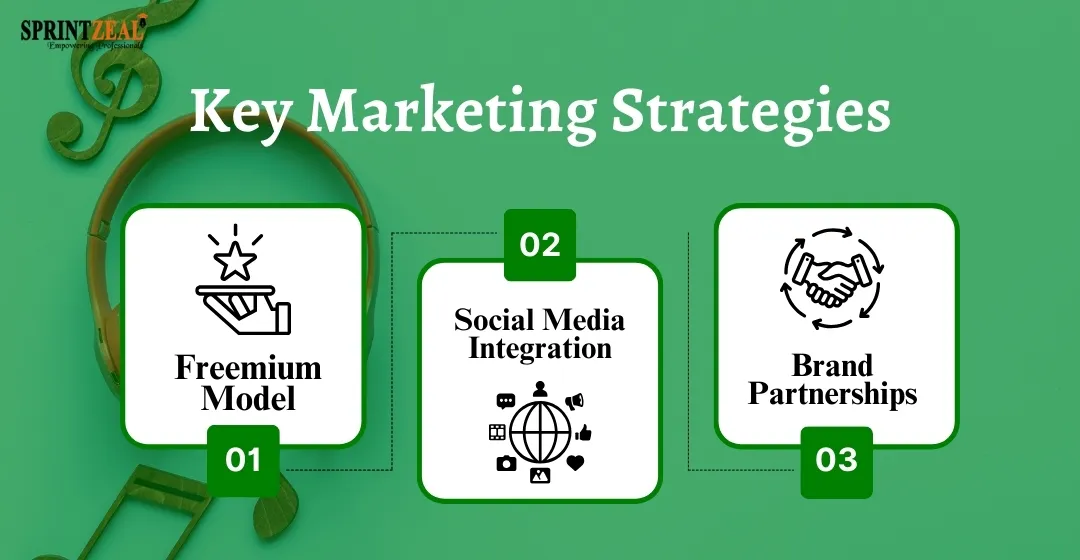
Spotify’s success is not only based on strong project management it also comes from its strategic marketing efforts. From the very beginning, Spotify understood that in the competitive music streaming market, success requires not only great innovative features but also required an effective marketing strategy.
Spotify’s main audience includes tech-savvy millennials who are also called Gen Y and Gen Z, who are engaged with social media and customized experiences. Spotify’s ads and campaigns are designed with keeping mainly those users in mind, emphasizing convenience, personalization, and the value of curated playlists.Spotify's advertising strategies and promotional campaigns prioritize keeping those users in mind, highlighting convenience, personalized content, and the benefits of expertly curated playlists.
- Freemium Model: Offering both free and premium subscriptions has been essential for attracting new users. The freemium model allows individuals to experience Spotify without any upfront costs, thereby enhancing the conversion rates to premium subscriptions.
- Social Media Integration: Spotify thrives on social media. It frequently partners with influencers and shares user-generated content, like playlists on Instagram, driving engagement and brand awareness.
- Brand Partnerships: Collaborations with renowned brands like Nike and Starbucks enables Spotify to deliver exceptional tailored experiences that resonate users further strengthening its presence in the market.
Spotify’s sustained success is not based upon luck; it's their mix of strengths, opportunities, and constant innovation that result in success. Let’s break this into simpler steps,
Strengths:
- Brand Recognition:
Spotify has established itself as the dominant player in the music industry because of the market share ,brand identity with millions of active users.
- Data-Driven Personalization:
The platform’s ability to provide personalized playlists and recommendations by using artificial intelligence and machine learning technologies keeps users suggesting new artists and songs.
- Extensive Library:
Spotify’s vast catalog of music, podcasts, and playlists serves diverse tastes.
- Partnerships:
Collaborations with artists and brands help keep Spotify top of mind.
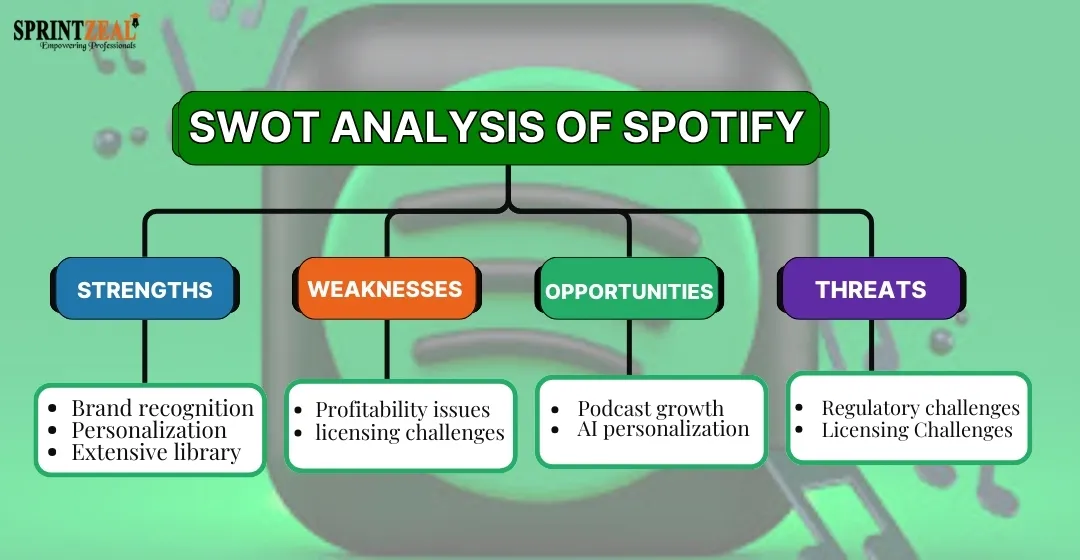
Weaknesses:
- Profitability Challenges:
Although spotify enjoys a substantial user base ,it continues to face difficulties in achieving consistent profitability.
- Dependence on Licenses:
High licensing costs and negotiations with music labels pose a significant challenge.
- Limited Control Over Content:
Spotify doesn’t create its own content, leaving it vulnerable to shifts in the industry.
Opportunities:
- Expansion:
In the Near Future there is a vast opportunity in Spotify's as it operates globally.
- Podcast Growth:
The podcast trend is experiencing significant growth ,presenting spotify with an opportunity to broaden its service and expand its subscriber base
- Enhanced Personalization:
There are continuous investment in artificial intelligence so there is a potential to enhance spotify's recommendations algorithms which results user engagement
Threats:
- Licensing Changes:
As licensing deals evolve, costs could rise that will affect profitability.
- Regulatory Challenges:
As Spotify continues to grow, it may face challenges related to data privacy and the music licensing industry.
Spotify's journey from a small startup to a dominant global player highlights the crucial role of project management and strategic marketing and also by adopting agile methodologies, enhancing teamwork, minimizing risks, and promoting ongoing innovation, made Spotify revolutionized music streaming and also set a standard for technology companies to successfully navigate competitive landscapes.

With its strong marketing strategies,from the freemium model to brand collaborations it is continuously growing and engaging users in ways few companies can replicate. Coupled with its careful SWOT analysis, Spotify's ability to adapt, innovate, and stay ahead of market trends guarantees that the beat will keep playing for more years to come.
Sprintzeal's Business Management Training Certifications: Your One-Stop Solution for Business Growth

Sprintzeal offers top-tier CBAP Certification Training designed to equip you with the essential skills to excel in business analysis. Our world-class training programs will help you master the art of managing business projects effectively, allowing you to drive success and growth in your career. Additionally, our Project Management Certification Programs will empower you to manage projects like a professional, ensuring you are prepared to handle even the most complex tasks with ease.
Contact Our Support Team to Get Started or for Any Inquiries

Sprintzeal
Fri, 06 December 2024
Wed, 16 October 2024

Tue, 01 October 2024


© 2024 Sprintzeal Americas Inc. - All Rights Reserved.

 USA : +1315-322-7821
 UK : +44 7700 174870
 IND : +919008230179
 AUS : +61 480 005 455
Leave a comment