Customer Experience (CX): Definition, Importance, and Strategies for Success
Tue, 25 February 2025

Follow the stories of academics and their research expeditions
People use the terms cloud services and cloud computing interchangeably, as both these terms mean almost the same thing.
Cloud services are infrastructure, platforms, or software that are hosted by third-party providers and made available to users through the Internet.
These services are designed to provide easy, affordable access to applications and resources, without the need for internal infrastructure or hardware.
Cloud services are growing in demand, as more and more businesses are transforming themselves into organizations that perform all their business operations on cloud platforms.
This drastic change in the way businesses handle their activities using cloud platforms is like a wave that will sweep across all kinds of industries around the globe and transform them into something that is beyond anyone’s imagination.
Now, let us look at the advantages that cloud services provide a business. There are several benefits of using cloud services. The major ones are given below:

- Scalability
The businesses are able to adjust the number of resources needed for their operations, thus the cost is reduced and the company is able to modify the number of resources used based on the circumstances.
Scalability occurs in two ways; increasing user licenses during business booms or enhancing application software to cater to a growing business.
- Low Cost
There is no need of IT hardware and software infrastructure in a cloud service-based business. The only thing they have to spend their money on is a monthly or annual subscription of the cloud service providers. Which immensely reduces the cost of business operations.
- Enhanced Flexibility
The flexibility provided by cloud services helps businesses to adapt according to the demands of their customers. This reduces the company’s resource expenditure and thus allows the company to invest its resources into something more important.
- High Processing Speeds
Cloud services use advanced algorithms which optimize servers and find the most efficient routes to guide data traffic. This leads to high-speed completion of tasks and helps save precious time.
- Data Security
For a system that stores large quantities of customer data, cloud services stay up to date with the latest security measures to avoid threats to that data.
After learning about the different benefits of cloud computing, let us take a look at the cloud deployment models.
There are basically two cloud deployment models and the third one is a combination of the previous two. Let us look at the features of each of these models.
Organizations that use cloud services should be able to select deployment models that work best for their operations.
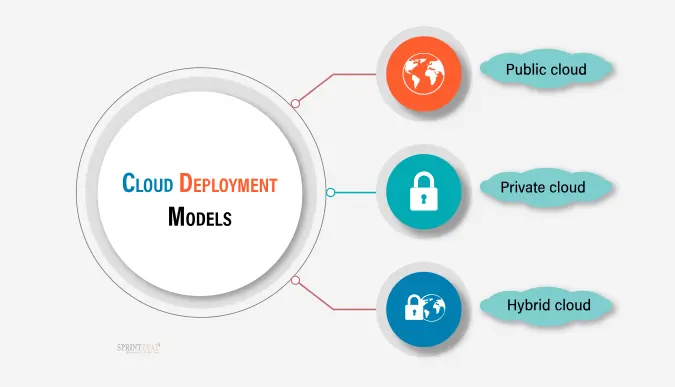
- Public cloud
Public cloud services are delivered to numerous people through the web. Public clouds enable cloud resources to be shared at scale to multiple users called “tenants.”
The public cloud is accessible to the customers and the only real issue is the security threats that these services face due to the multiple access points that is provided by the Public cloud services
- Private cloud
A private cloud is a cloud infrastructure that is deployed to a single organization.
Private clouds are ideal for organizations that work with sensitive data, notably insurance, banking, and healthcare.
Such organizations use private clouds to utilize advanced security and control measures and extend resources on-demand using a virtual environment.
- Hybrid cloud
This type of deployment model as mentioned above is a combination of Public and Private cloud models.
It consists of the advantages of the two basic models and aims at reducing the disadvantages of both models.
This type of cloud deployment model is used by businesses that have unique requirements and unorthodox ways of operating.
After understanding the cloud deployment models, let us look into the three major types of cloud services.
Software as a Service (SaaS)
SaaS is a licensing model in which access to software is provided on a subscription basis, where the software is located on external servers rather than on servers located in-house.
The SaaS model offers a variety of services such as file storage, backup data system, web-based email, and project management tools.
Cloud software is distributed using a cloud-native application architecture. Users do not need to manage and maintain the underlying cloud infrastructure, which consists of an operating system, network, servers, storage, and other applications.
SaaS cloud service providers include Microsoft Office 365, Google Workspaces, Dropbox, Salesforce, Square Veeva, etc.
Infrastructure as a Service (IaaS)
Infrastructure-as-a-Service, commonly referred to as simply “IaaS,” is a form of cloud computing that delivers fundamental computing, network, and storage resources to consumers on-demand, over the internet, and on a pay-as-you-go basis.
IaaS services include raw block storage, file and object storage, load balancing, application firewalls, virtual machine disk image library, software bundles, virtual local area networks (VLANs), and IP addresses.
Examples of IaaS vendors include-
Amazon Web Services (AWS) – Amazon Elastic Computer Cloud (EC2)
Microsoft Azure – Azure Virtual Machines
Google Cloud Platform (GCP) – Compute Engine
IBM Cloud
Alibaba Cloud – Alibaba Elastic Compute Service
Oracle Cloud Infrastructure
Platform as a Service (PaaS)
Platform as a service (PaaS) is a complete development and deployment environment in the cloud, with resources that enable you to deliver everything from simple cloud-based apps to sophisticated, cloud-enabled enterprise applications.
You purchase the resources you need from a cloud service provider on a pay-as-you-go basis and access them over a secure Internet connection.
Using a PaaS service allows customers to forgo investment into the underlying software and hardware layers essential for application development.
Examples of PaaS vendors include-
Microsoft Azure
Amazon Web Service (AWS) Elastic Beanstalk
Google App Engine
Salesforce aPaaS
Red Hat OpenShift PaaS
IBM Cloud Platform
There exist other types of cloud services like - Serverless computing, Function as a Service (FaaS), etc.
In the future, there is a chance of a complete shift to the cloud, as organizations choose cloud services over other traditional options available.
There are some rising trends that show that the future of cloud computing is bright. Some of them are given below:
- Increase in demand for hybrid and multi-cloud approaches
- Artificial intelligence (AI) will increase the efficiency of cloud services
- Demand for virtual cloud desktops will rise significantly
- Collaboration and productivity tools are expected to enjoy widespread use
- Healthcare to continue migration to the cloud for security and productivity reasons
- Continued growth in serverless computing
- Cloud gaming popularity will increase
The above trends show us that the dependency of people on cloud services will increase dramatically in just a couple of years.
We thank you for accompanying us on this journey. Hope you are satisfied with the information you gained through this article. We also encourage you to share this information with those in need.
The cloud computing industry has a lot of uncovered potential that needs enthusiastic people to excavate. For people who are exploring their options regarding their future careers, this article would have provided you with the clarity you were looking for.
Let’s have a quick recap of what we learned from this article.
We learned about cloud services and their meaning, the benefit it provides to a business, its deployment models, their types, and at last it’s future.
Those of you who aspire to become a certified professional in the cloud computing industry can take a look at the courses recommended by us-
CompTIA Cloud Essentials+ Certification
To learn more about the courses that we provide visit us at Sprintzeal
People use the terms cloud services and cloud computing interchangeably, as both these terms mean almost the same thing.
Cloud services are infrastructure, platforms, or software that are hosted by third-party providers and made available to users through the Internet.
These services are designed to provide easy, affordable access to applications and resources, without the need for internal infrastructure or hardware.
Cloud services are growing in demand, as more and more businesses are transforming themselves into organizations that perform all their business operations on cloud platforms.
This drastic change in the way businesses handle their activities using cloud platforms is like a wave that will sweep across all kinds of industries around the globe and transform them into something that is beyond anyone’s imagination.
Now, let us look at the advantages that cloud services provide a business. There are several benefits of using cloud services. The major ones are given below:
- Scalability
The businesses are able to adjust the number of resources needed for their operations, thus the cost is reduced and the company is able to modify the number of resources used based on the circumstances.
Scalability occurs in two ways; increasing user licenses during business booms or enhancing application software to cater to a growing business.
- Low Cost
There is no need of IT hardware and software infrastructure in a cloud service-based business. The only thing they have to spend their money on is a monthly or annual subscription of the cloud service providers. Which immensely reduces the cost of business operations.
- Enhanced Flexibility
The flexibility provided by cloud services helps businesses to adapt according to the demands of their customers. This reduces the company’s resource expenditure and thus allows the company to invest its resources into something more important.
- High Processing Speeds
Cloud services use advanced algorithms which optimize servers and find the most efficient routes to guide data traffic. This leads to high-speed completion of tasks and helps save precious time.
- Data Security
For a system that stores large quantities of customer data, cloud services stay up to date with the latest security measures to avoid threats to that data.
After learning about the different benefits of cloud computing, let us take a look at the cloud deployment models.
There are basically two cloud deployment models and the third one is a combination of the previous two. Let us look at the features of each of these models.
Organizations that use cloud services should be able to select deployment models that work best for their operations.
- Public cloud
Public cloud services are delivered to numerous people through the web. Public clouds enable cloud resources to be shared at scale to multiple users called “tenants.”
The public cloud is accessible to the customers and the only real issue is the security threats that these services face due to the multiple access points that is provided by the Public cloud services
- Private cloud
A private cloud is a cloud infrastructure that is deployed to a single organization.
Private clouds are ideal for organizations that work with sensitive data, notably insurance, banking, and healthcare.
Such organizations use private clouds to utilize advanced security and control measures and extend resources on-demand using a virtual environment.
- Hybrid cloud
This type of deployment model as mentioned above is a combination of Public and Private cloud models.
It consists of the advantages of the two basic models and aims at reducing the disadvantages of both models.
This type of cloud deployment model is used by businesses that have unique requirements and unorthodox ways of operating.
After understanding the cloud deployment models, let us look into the three major types of cloud services.
Software as a Service (SaaS)
SaaS is a licensing model in which access to software is provided on a subscription basis, where the software is located on external servers rather than on servers located in-house.
The SaaS model offers a variety of services such as file storage, backup data system, web-based email, and project management tools.
Cloud software is distributed using a cloud-native application architecture. Users do not need to manage and maintain the underlying cloud infrastructure, which consists of an operating system, network, servers, storage, and other applications.
SaaS cloud service providers include Microsoft Office 365, Google Workspaces, Dropbox, Salesforce, Square Veeva, etc.
Infrastructure as a Service (IaaS)
Infrastructure-as-a-Service, commonly referred to as simply “IaaS,” is a form of cloud computing that delivers fundamental computing, network, and storage resources to consumers on-demand, over the internet, and on a pay-as-you-go basis.
IaaS services include raw block storage, file and object storage, load balancing, application firewalls, virtual machine disk image library, software bundles, virtual local area networks (VLANs), and IP addresses.
Examples of IaaS vendors include-
Amazon Web Services (AWS) – Amazon Elastic Computer Cloud (EC2)
Microsoft Azure – Azure Virtual Machines
Google Cloud Platform (GCP) – Compute Engine
IBM Cloud
Alibaba Cloud – Alibaba Elastic Compute Service
Oracle Cloud Infrastructure
Platform as a Service (PaaS)
Platform as a service (PaaS) is a complete development and deployment environment in the cloud, with resources that enable you to deliver everything from simple cloud-based apps to sophisticated, cloud-enabled enterprise applications.
You purchase the resources you need from a cloud service provider on a pay-as-you-go basis and access them over a secure Internet connection.
Using a PaaS service allows customers to forgo investment into the underlying software and hardware layers essential for application development.
Examples of PaaS vendors include-
Microsoft Azure
Amazon Web Service (AWS) Elastic Beanstalk
Google App Engine
Salesforce aPaaS
Red Hat OpenShift PaaS
IBM Cloud Platform
There exist other types of cloud services like - Serverless computing, Function as a Service (FaaS), etc.
In the future, there is a chance of a complete shift to the cloud, as organizations choose cloud services over other traditional options available.
There are some rising trends that show that the future of cloud computing is bright. Some of them are given below:
- Increase in demand for hybrid and multi-cloud approaches
- Artificial intelligence (AI) will increase the efficiency of cloud services
- Demand for virtual cloud desktops will rise significantly
- Collaboration and productivity tools are expected to enjoy widespread use
- Healthcare to continue migration to the cloud for security and productivity reasons
- Continued growth in serverless computing
- Cloud gaming popularity will increase
The above trends show us that the dependency of people on cloud services will increase dramatically in just a couple of years.
We thank you for accompanying us on this journey. Hope you are satisfied with the information you gained through this article. We also encourage you to share this information with those in need.
The cloud computing industry has a lot of uncovered potential that needs enthusiastic people to excavate. For people who are exploring their options regarding their future careers, this article would have provided you with the clarity you were looking for.
Let’s have a quick recap of what we learned from this article.
We learned about cloud services and their meaning, the benefit it provides to a business, its deployment models, their types, and at last it’s future.
Those of you who aspire to become a certified professional in the cloud computing industry can take a look at the courses recommended by us-
CompTIA Cloud Essentials+ Certification
To learn more about the courses that we provide visit us at Sprintzeal

Sprintzeal
Tue, 25 February 2025
Mon, 31 March 2025

Tue, 25 February 2025


© 2024 Sprintzeal Americas Inc. - All Rights Reserved.

 USA : +1315-322-7821
 UK : +44 7700 174870
 IND : +919008230179
 AUS : +61 480 005 455
Leave a comment