What Is Edge Computing? Types, Applications, and the Future
Fri, 06 December 2024

Follow the stories of academics and their research expeditions
In today's business environment, which is so competitive, organisations require planning their work properly to achieve some specific goals. A project in project management directly leads to a temporary goal of business that is taken on to build a unique product or service within a certain time period. Projects can change in size and complexity. Some projects may involve building infrastructure; some others focus on developing software or launching a new website.
If we see the job opportunities offered by different companies, for which we take data from LinkedIn and Indeed job portals, the statistics we compare below change over time. Project management jobs have increased from 2020 to 2026. The number are increasing project-related roles has grown. It shows strong global demand for project management skills.
The salary of project managers has slowly increased between 2020 and 2026. As companies are doing more project-related work and digital transformation, professionals with project management skills are earning higher salaries.
A project is a short-term activity taken out to achieve a specific objective set up by a business. Helps create something new, such as a product or service. Unlike regular work that is done every day, a project has its clear beginning and a defined end. Projects are actually created to solve a certain problem in the company, improve a work process, and introduce something new. If the setted objective is achieved, the project is considered complete.
Project management confirms that all project activities are created properly and assigned so teams can work with their full potential. A good plan helps manage tasks, control budget, and assign team duties so that the project goes in the right direction and achieves the expected goal.
The key characteristics of the project are discussed in detail below.
A project, before starting it, has a specific start date and end date. It exists only for a certain fixed period until the desired goal is achieved.
Every project gives a unique outcome. That could be a new product, a service, a system that did not exist before.
Projects begin with certain clearly defined objectives. These goals assist the team and help everyone understand what the project is expected outcomes to achieve.
Projects generally operate within certain points of control such as budget, time, team member, and materials. Managing these resources properly is the first priority for project success.
Some common examples of projects are
To Develop a mobile application for customers
Constructing a house or office building.
Start a marketing campaign for a new product business
Each of these examples has a clear goal, timeline, and set of tasks, which itself makes them projects in the context of project management.
The project scope explains the limits of a project and defines the work to do to achieve goal that has an expected outcome. Its defined project scope helps teams stay engaged and remove misunderstandings during the work on the project. It also supports project managers in allocating resources fully and tracking progress more potentially.
When the scope is properly defined, team members understand their work and responsibility and can work on completing their tasks in an organized manner.
Every project starts with defined objectives. results that the project is expected to produce.
The scope has a timeline that presents when the project will start, important milestones, and the assumed completion date.
Projects usually have financial issues. The scope defines how much money should be spent on finishing the project.
The teamwork in the project has different tasks to complete, and they are responsible for it. They should understand their work and role in it.
Project type | Short Description | Examples |
IT Software | Project focused on developing software or digital technology solutions | Mobile Apps, Website |
Research Project | Projects conducted to discover new ideas or gain knowledge through investigation | Scientific studies, medical research |
Business Project | Projects are created to improve business performance or launch new products. | Marketing campaigns, product launches |
To understand how projects work in real life. for example, a website development project. Companies create websites to promote their products and services online. Developing a website is a good example of a project because it involves a set of tasks that must be completed within a specific time to develop the website.
Below are the list of stages involved in a website development project and how project management supports each stage.
The first step of beginning a project is planning it. Here, the team knows the reason for creating the website, who the target audience is, and what features are included.
In this stage, designers create the visual layout of the website using graphical tools. This includes selecting colors, fonts, layouts, and user interface elements that are required to be use to create the website. Project management requires that the design meet the project goal and get approval from stakeholders before starting development.
During the development stage, the programmers team starts creating the website using coding languages and development tools similar to what the graphical team designed for the website. So, the manager can track the website and assign new work to them.
It should be necessary to test the website before it launches to check that everything works properly. The team checks operation functionalities, loading speed, mobile responsiveness, and security in this stage. Project management helps resolve if any issue occurs there so the website performs properly on the online server.
In the last stage of the project, the website goes live and is accessible for the user. The project manager checks that all the expectations are fulfilled in the website according to objectives.
The phrases project framework and project methodology are regularly used words in project management, but they are not the same, and they both help teams in managing projects efficiently; they have different goals to perform in project management.
A project is seen as successful when it meets and fulfills its objectives in creating the project outline and benefits the business and its stakeholders. In project management, success is defined by more than just finishing the task; it also depends on how effectively the project achieves and its goals. also successfully controlling time, cost, and quality in completing the project development.
Below are some key factors that determine whether a project is successful :
A successful project is finished within the planned targetted date. The meeting date, which is set as the deadline, is most important because delays can positively affect business operations, increase budget, and reduce clients confidence.
Every project has a financial set budget limit. If the project is completed without overdrawing from the allocated budget, it shows that resources were managed properly in the projects working.
The project has to meet the goals which set during the planning stage. If the projects goal is met by the final result, it can be called a success.
Stakeholders, which include clients, managers, team members, and persons involved in the project. A project is successful when it confirms that it meets their expected results and delivers the value that they were looking for in the outcome of the project.
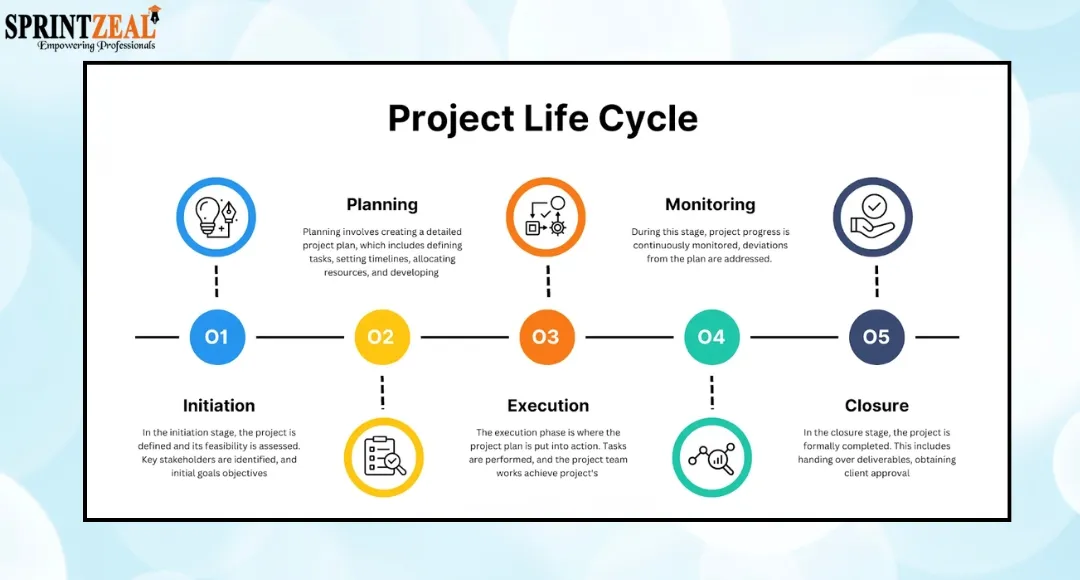
A project life cycle is a framework that includes a number of separate, high-level steps that must be followed in order to turn an idea or concept into reality in an orderly and efficient way.
Life cycles provide a structured and systematic approach to project-based work and can be regarded as the framework supporting deployment.
5 Stages of Project Management Lifecycle
Understanding the five project management life cycle phases and their requirements will give you a repeatable, improvable framework for effective project management.
Before any deep planning, a projects potential and worth are reviewed during the beginning phase. The goals, scope, purpose, and stakeholders are established during this stage.
Tasks, which include:
Making a case for business
Doing a study for a business
Finding stakeholders
Making sure that everyone is aware of the projects objectives is the focus of the phase. For this reason, you need both resources and permission to proceed on to the planning stage.
At the planning stage of the project life cycle, a project roadmap is create. will break the project down into smaller parts, set deadlines, and make a detailed plan for calendars, tools, resources, and who will do what.
Project Execution
During the project execution phase, you put the project plan into action and finalize the final outcome. As the project manager, you may have to do the following:
With the key performance indicators explained, did the works going in right direction or not.
Monitoring and Controlling
Here a project progress tracker can track and make modifications according to objectives. Data would be collected from timesheets and reports.
Use timeline views in your project management software to always know you project is going in the right direction.
In this stage, conclude the project completion. The outcome is handed over to the stakeholder. The manager and team member can see the outcome and learn and close the project.
The 7P model is a basic project management approach with unique principles that marketers can use to develop and implement strategies that may help attract and engage consumers, improve sales, and increase revenue. As products, markets, customers, and demands change so quickly, it is beneficial for companies to evaluate the seven Ps regularly to ensure that they are on track and getting the best outcomes possible in the market.
Below are the seven components of the 7P model explained briefly.
A product is any goods, service that a business can offer to a market to satisfy a want or need. Physical products require consideration like design and quality, while services often prioritise quality and consumer relations.
The placement principle concerns where a company makes its products available, such as a physical storefront or a website. This principle helps marketers to determine where they can promote their products to their companies target customers
The people who work in marketing are the people who make up the marketing and sales teams that use the 7P of marketing. These people help customers, building relationships with them, and come up with ways to make the customer experience better in all areas.
The 7Ps of marketing involve both the processes that a company goes through to create products and the processes that it goes through to promote and sell new products. This principle aids marketers in refining production processes, improving promotional activities and increasing product sales.
This principle involves increasing public knowledge about a company and its products and services. Marketers use this principle to identify where and how to advertise relevant products and services to target customers.
The goal of the pricing principle in marketing is to help a company select a suitable price for a product. Marketers apply this kind of principle by analysing competitors performance, calculating costs, and setting product prices.
This principle means making proof that makes a brand look better and the quality of its products better, and it also means getting more people to know about a business. The 7Ps of marketing all work together to help marketers use this part.
Agile project management is a process of dividing a project into smaller parts, which are known as iterations. These iterations have different stages like planning, development, and review. This structure allows Teams to respond more quickly to required changes and improvise the products they are building. For this, they add value throughout the entire project rather than waiting until the end.
This approach is used in industries include software development, product management, and digital services because of quick updates and adaptations' motivation for improvement.
Types of Agile Methodologies
Agile project management is a broad concept, it includes many frameworks and practices. Some of the mainly used Agile methodologies are Scrum and the Kanban project framework.
The Scrum framework is popular where it is used for projects requiring change. It helps. Organize work into short development iteration cycles. In the last two to four weeks.
In the start of each step, the team would define a clear objective and plan accordingly and complete it in that period. The team takes daily wise meetings to discuss the progress, identify the blockers, and adjust tasks if necessary.
At the end of iteration, the team reviews the completed work and collects feedback. This improves their processes of work and planning the next iteration more effectively.
Kanban is an agile method focused on visualizing tasks and managing their workflow efficiently. Teams usually use Kanban to track their work. The board usually includes columns such as TO, Progress, and Completed.
Each task goes to the broad members as it progresses, make it easy to see each team the status of current work.
Kanban has limiting work in progress. It can control many task handled at once. So, a team can maintain continuous workflow and avoid overload.
Agile methods are used in software development because they helps to deliver products quickly and improve them time to time.
Instead of building the entire product, agile teams work in short development cycles. In each cycle, they design, develop, test, and release new features. Feedback are used to update the product
This iterative process makes the product stay relevant to users and requires to changing requirements.
stages:
Concept : Here the projects main idea is defined, according to which the project mission and goals are prepared.
Inception : Here project are formed and prepared by the team. Roles are assigned, and the project environment is designed.
Iteration : In this stage, developers write and update the code while considering feedback from customers and stakeholders
Release : The developed code is tested thoroughly to identify and fix any issue before it is delivered to users
Maintainance : After the product is launched, the team provides technical support and continues to update the product to ensure it stay functional useful
Retirement : Every product reaches the end of its lifecycle. When this happens, the product is retired, and a new solution may be developed to replace it.
Learning project management skills is easier because many online educational platforms (edutech) provide courses & certifications. This platform helps beginners and professionals improve their knowledge and get hands-on experience.
Sprintzeal also provides the best project management training and certification program with the best live lecture projects. Which include PMP certification, Agile training, and other professional programs. We help professionals gain industry-recognized project skills.
Coursera edutech platform provides project management courses from top universities. Learners can get skills such as project planning, agile methodology, and risk management. With professional certification that helps improve career opportunities.
Udemy another popular edutech platform, offers affordable courses like project management. It also provides training tools, agile practices, and PMP preparation in the course period. They also provide video lectures and practical, accessible materials.
Projects are important in project management because they help managers organize the work, collect resources, and meet deadlines in a structured way. In corporate companies, managing projects properly is key to completing work on time and achieving the objective efficiently.
Applying effective project planning and coordination managers can reduce risk, improve team collaboration, make better results for business. Project management helps business to handle complex work more efficiently and support for long term.
1. What is Kissflow Project?
Kissflow is a project management tool that make easy for businesses to keep aligned with tasks, given to the right people, see how things are going happen, and work with their team. kissflow makes their work flow better, get more business, and finish projects on time.
2. What is a project management workflow?
A project management workflow is steps that show the start of a project to the end. A clear workflow clarifies everyone knows what their job is and all tasks are done in the right order. This helps projects go smoothly and quickly.
3. How does resource management help in project management?
Resource management helps project managers utilize the resources in proper way. Like people, tools, and materials that are available for the project. With this, people can do work properly without investing extra money and having any problems; more people more productive.
4. Why is risk management important in project management?
Risk management is an important because it helps find potential problems. The project managers job is to handle these risk at the initial stage so that teams don't fall behind.
A project is a short-term activity taken out to achieve a specific objective set up by a business. Helps create something new, such as a product or service. Unlike regular work that is done every day, a project has its clear beginning and a defined end. Projects are actually created to solve a certain problem in the company, improve a work process, and introduce something new. If the setted objective is achieved, the project is considered complete.
Project management confirms that all project activities are created properly and assigned so teams can work with their full potential. A good plan helps manage tasks, control budget, and assign team duties so that the project goes in the right direction and achieves the expected goal.
The key characteristics of the project are discussed in detail below.
A project, before starting it, has a specific start date and end date. It exists only for a certain fixed period until the desired goal is achieved.
Every project gives a unique outcome. That could be a new product, a service, a system that did not exist before.
Projects begin with certain clearly defined objectives. These goals assist the team and help everyone understand what the project is expected outcomes to achieve.
Projects generally operate within certain points of control such as budget, time, team member, and materials. Managing these resources properly is the first priority for project success.
Some common examples of projects are
Each of these examples has a clear goal, timeline, and set of tasks, which itself makes them projects in the context of project management.
The project scope explains the limits of a project and defines the work to do to achieve goal that has an expected outcome. Its defined project scope helps teams stay engaged and remove misunderstandings during the work on the project. It also supports project managers in allocating resources fully and tracking progress more potentially.
When the scope is properly defined, team members understand their work and responsibility and can work on completing their tasks in an organized manner.
Every project starts with defined objectives. results that the project is expected to produce.
The scope has a timeline that presents when the project will start, important milestones, and the assumed completion date.
Projects usually have financial issues. The scope defines how much money should be spent on finishing the project.
The teamwork in the project has different tasks to complete, and they are responsible for it. They should understand their work and role in it.
|
Project type |
Short Description |
Examples |
|
IT Software |
Project focused on developing software or digital technology solutions |
Mobile Apps, Website |
|
Research Project |
Projects conducted to discover new ideas or gain knowledge through investigation |
Scientific studies, medical research |
|
Business Project |
Projects are created to improve business performance or launch new products. |
Marketing campaigns, product launches |
To understand how projects work in real life. for example, a website development project. Companies create websites to promote their products and services online. Developing a website is a good example of a project because it involves a set of tasks that must be completed within a specific time to develop the website.
Below are the list of stages involved in a website development project and how project management supports each stage.
The first step of beginning a project is planning it. Here, the team knows the reason for creating the website, who the target audience is, and what features are included.
In this stage, designers create the visual layout of the website using graphical tools. This includes selecting colors, fonts, layouts, and user interface elements that are required to be use to create the website. Project management requires that the design meet the project goal and get approval from stakeholders before starting development.
During the development stage, the programmers team starts creating the website using coding languages and development tools similar to what the graphical team designed for the website. So, the manager can track the website and assign new work to them.
It should be necessary to test the website before it launches to check that everything works properly. The team checks operation functionalities, loading speed, mobile responsiveness, and security in this stage. Project management helps resolve if any issue occurs there so the website performs properly on the online server.
In the last stage of the project, the website goes live and is accessible for the user. The project manager checks that all the expectations are fulfilled in the website according to objectives.
The phrases project framework and project methodology are regularly used words in project management, but they are not the same, and they both help teams in managing projects efficiently; they have different goals to perform in project management.
A project is seen as successful when it meets and fulfills its objectives in creating the project outline and benefits the business and its stakeholders. In project management, success is defined by more than just finishing the task; it also depends on how effectively the project achieves and its goals. also successfully controlling time, cost, and quality in completing the project development.
Below are some key factors that determine whether a project is successful :
A successful project is finished within the planned targetted date. The meeting date, which is set as the deadline, is most important because delays can positively affect business operations, increase budget, and reduce clients confidence.
Every project has a financial set budget limit. If the project is completed without overdrawing from the allocated budget, it shows that resources were managed properly in the projects working.
The project has to meet the goals which set during the planning stage. If the projects goal is met by the final result, it can be called a success.
Stakeholders, which include clients, managers, team members, and persons involved in the project. A project is successful when it confirms that it meets their expected results and delivers the value that they were looking for in the outcome of the project.
A project life cycle is a framework that includes a number of separate, high-level steps that must be followed in order to turn an idea or concept into reality in an orderly and efficient way.
Life cycles provide a structured and systematic approach to project-based work and can be regarded as the framework supporting deployment.
5 Stages of Project Management Lifecycle
Understanding the five project management life cycle phases and their requirements will give you a repeatable, improvable framework for effective project management.
Before any deep planning, a projects potential and worth are reviewed during the beginning phase. The goals, scope, purpose, and stakeholders are established during this stage.
Tasks, which include:
Making sure that everyone is aware of the projects objectives is the focus of the phase. For this reason, you need both resources and permission to proceed on to the planning stage.
At the planning stage of the project life cycle, a project roadmap is create. will break the project down into smaller parts, set deadlines, and make a detailed plan for calendars, tools, resources, and who will do what.
During the project execution phase, you put the project plan into action and finalize the final outcome. As the project manager, you may have to do the following:
Here a project progress tracker can track and make modifications according to objectives. Data would be collected from timesheets and reports.
Use timeline views in your project management software to always know you project is going in the right direction.
In this stage, conclude the project completion. The outcome is handed over to the stakeholder. The manager and team member can see the outcome and learn and close the project.
The 7P model is a basic project management approach with unique principles that marketers can use to develop and implement strategies that may help attract and engage consumers, improve sales, and increase revenue. As products, markets, customers, and demands change so quickly, it is beneficial for companies to evaluate the seven Ps regularly to ensure that they are on track and getting the best outcomes possible in the market.
Below are the seven components of the 7P model explained briefly.
A product is any goods, service that a business can offer to a market to satisfy a want or need. Physical products require consideration like design and quality, while services often prioritise quality and consumer relations.
The placement principle concerns where a company makes its products available, such as a physical storefront or a website. This principle helps marketers to determine where they can promote their products to their companies target customers
The people who work in marketing are the people who make up the marketing and sales teams that use the 7P of marketing. These people help customers, building relationships with them, and come up with ways to make the customer experience better in all areas.
The 7Ps of marketing involve both the processes that a company goes through to create products and the processes that it goes through to promote and sell new products. This principle aids marketers in refining production processes, improving promotional activities and increasing product sales.
This principle involves increasing public knowledge about a company and its products and services. Marketers use this principle to identify where and how to advertise relevant products and services to target customers.
The goal of the pricing principle in marketing is to help a company select a suitable price for a product. Marketers apply this kind of principle by analysing competitors performance, calculating costs, and setting product prices.
This principle means making proof that makes a brand look better and the quality of its products better, and it also means getting more people to know about a business. The 7Ps of marketing all work together to help marketers use this part.
Agile project management is a process of dividing a project into smaller parts, which are known as iterations. These iterations have different stages like planning, development, and review. This structure allows Teams to respond more quickly to required changes and improvise the products they are building. For this, they add value throughout the entire project rather than waiting until the end.
This approach is used in industries include software development, product management, and digital services because of quick updates and adaptations' motivation for improvement.
Types of Agile Methodologies
Agile project management is a broad concept, it includes many frameworks and practices. Some of the mainly used Agile methodologies are Scrum and the Kanban project framework.
The Scrum framework is popular where it is used for projects requiring change. It helps. Organize work into short development iteration cycles. In the last two to four weeks.
In the start of each step, the team would define a clear objective and plan accordingly and complete it in that period. The team takes daily wise meetings to discuss the progress, identify the blockers, and adjust tasks if necessary.
At the end of iteration, the team reviews the completed work and collects feedback. This improves their processes of work and planning the next iteration more effectively.
Kanban is an agile method focused on visualizing tasks and managing their workflow efficiently. Teams usually use Kanban to track their work. The board usually includes columns such as TO, Progress, and Completed.
Each task goes to the broad members as it progresses, make it easy to see each team the status of current work.
Kanban has limiting work in progress. It can control many task handled at once. So, a team can maintain continuous workflow and avoid overload.
Agile methods are used in software development because they helps to deliver products quickly and improve them time to time.
Instead of building the entire product, agile teams work in short development cycles. In each cycle, they design, develop, test, and release new features. Feedback are used to update the product
This iterative process makes the product stay relevant to users and requires to changing requirements.
stages:
Learning project management skills is easier because many online educational platforms (edutech) provide courses & certifications. This platform helps beginners and professionals improve their knowledge and get hands-on experience.
Sprintzeal also provides the best project management training and certification program with the best live lecture projects. Which include PMP certification, Agile training, and other professional programs. We help professionals gain industry-recognized project skills.
Coursera edutech platform provides project management courses from top universities. Learners can get skills such as project planning, agile methodology, and risk management. With professional certification that helps improve career opportunities.
Udemy another popular edutech platform, offers affordable courses like project management. It also provides training tools, agile practices, and PMP preparation in the course period. They also provide video lectures and practical, accessible materials.
Projects are important in project management because they help managers organize the work, collect resources, and meet deadlines in a structured way. In corporate companies, managing projects properly is key to completing work on time and achieving the objective efficiently.
Applying effective project planning and coordination managers can reduce risk, improve team collaboration, make better results for business. Project management helps business to handle complex work more efficiently and support for long term.
Kissflow is a project management tool that make easy for businesses to keep aligned with tasks, given to the right people, see how things are going happen, and work with their team. kissflow makes their work flow better, get more business, and finish projects on time.
A project management workflow is steps that show the start of a project to the end. A clear workflow clarifies everyone knows what their job is and all tasks are done in the right order. This helps projects go smoothly and quickly.
Resource management helps project managers utilize the resources in proper way. Like people, tools, and materials that are available for the project. With this, people can do work properly without investing extra money and having any problems; more people more productive.
Risk management is an important because it helps find potential problems. The project managers job is to handle these risk at the initial stage so that teams don't fall behind.

Sprintzeal
Fri, 06 December 2024
Wed, 16 October 2024

Tue, 01 October 2024


© 2024 Sprintzeal Americas Inc. - All Rights Reserved.

 USA : +1315-322-7821
 UK : +44 7700 174870
 IND : +919008230179
 AUS : +61 480 005 455
Leave a comment